
UK Horse Racing Form Analysis: A Practical Guide to Reading Form for Handicap Races
Best Greyhound Betting Sites – Bet on Greyhounds in 2026
Loading...
Every Handicap Result Leaves Clues — Here’s How to Find Them
A handicap race is a story told in numbers, abbreviations and patterns. The racecard, the form book and the result archive contain the evidence you need to assess whether a horse is likely to outperform its official mark — but only if you know where to look and what the patterns mean. In a typical field of eleven to thirteen runners, only two or three horses on average will perform above their BHA rating. The form is the story — learn to read it, and you are reading the narrative of which two or three those might be.
Form analysis is not about predicting winners with certainty. It is about narrowing a field, eliminating the horses whose recent runs suggest they cannot win under today’s conditions, and focusing attention on those whose profiles align with the race at hand. The process is methodical, repeatable, and improves with practice. What follows is a working guide — practical, specific to UK handicaps, and grounded in the data that the BHA and commercial providers make publicly available.
A word of calibration before we begin: form analysis does not replace an understanding of the handicapping system. It sits on top of it. Knowing that a horse is rated 85 is the starting point. Knowing that its last three runs were over the wrong distance, on unsuitable ground, with a jockey who could not claim — and that today’s conditions are different on all three counts — is where the analysis begins.
The BHA handicapping system compresses ability into a single number, but ability is not a single thing. A horse’s performance varies with ground, distance, course configuration, pace, jockey, fitness, headgear and the quality of opposition it faces. Form analysis decompresses that number, examining the conditions under which each performance was produced and asking whether today’s conditions are more or less favourable. The horse rated 85 on its BHA mark might be a 90 horse on soft ground over a mile and a half at Haydock, and a 78 horse on firm ground over a mile at Ascot. The rating does not tell you that. The form does.
Decoding the Racecard: Form Figures, Headgear, Weight and Draw
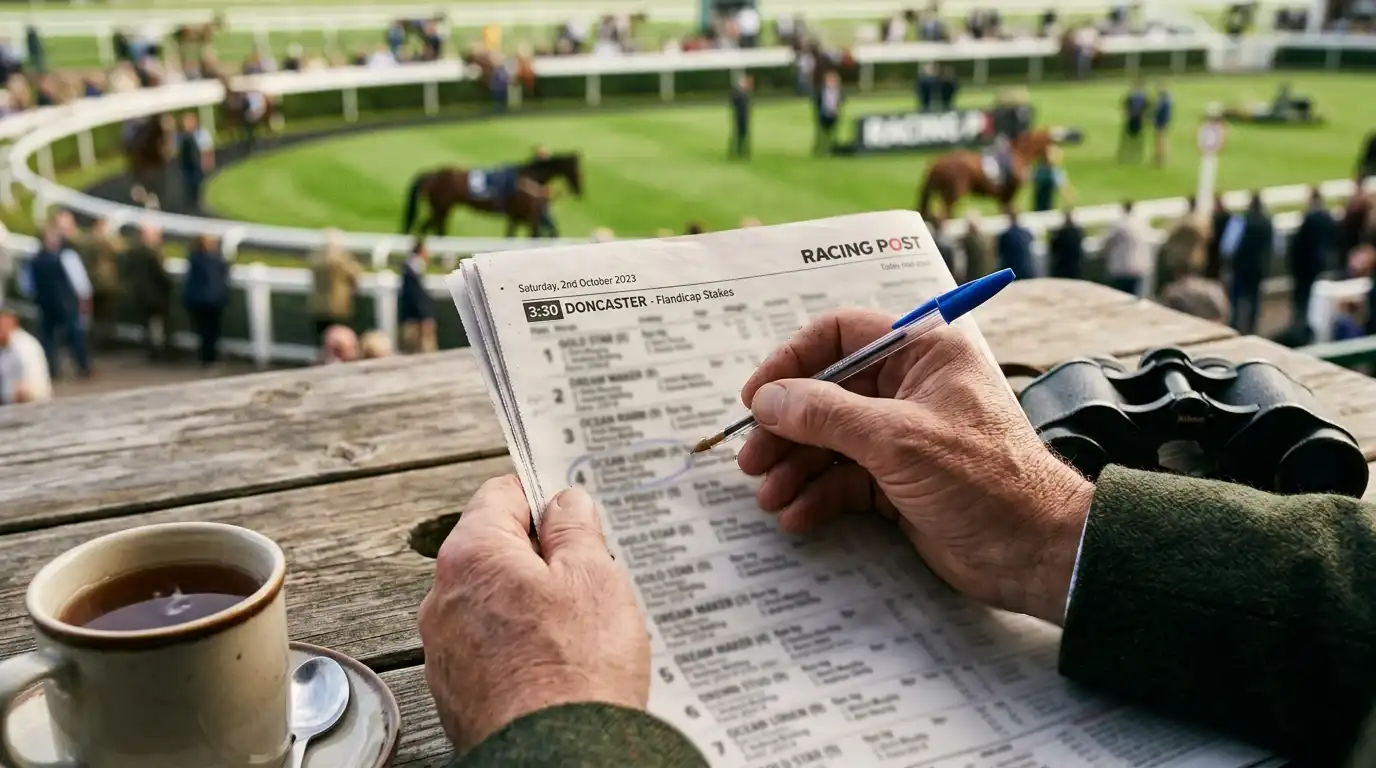
The UK racecard compresses a remarkable amount of information into a small space. Each horse’s entry typically includes its name, age, sex, weight to carry, Official Rating, recent form figures, draw position, jockey, trainer, headgear codes, days since last run, and ownership details. Every element is a data point, and the most useful analysis reads them as an interconnected system rather than isolated facts.
Form figures are displayed in chronological order, with the most recent run on the right. A sequence of 0342-1 tells you the horse was unplaced, then third, then fourth, then second — all in the previous season — before winning its most recent start in the current campaign. The hyphen marks the boundary between seasons. Letters replace numbers for specific outcomes: F for fell, U for unseated rider, P for pulled up, R for refused, B for brought down. In handicap analysis, the circumstances behind each figure matter far more than the figure itself. A horse that finished fourth of six in a Class 2 at Ascot probably ran a stronger race than one that finished second of four in a Class 6 at Southwell.
The BHA updates ratings every Tuesday, which means form figures from more than two weeks ago may already have been factored into a revised official mark. Fresh form — particularly the last run — carries disproportionate weight in market pricing, but the handicapper may have already adjusted for it. Checking the date of the most recent rating change, displayed on most online form guides, tells you whether the market is pricing information the handicapper has already incorporated.
Headgear codes appear next to the horse’s name. The key abbreviations are: b (blinkers), v (visor), t (tongue tie), p (cheekpieces), h (hood). A superscript “1” denotes first-time application. First-time blinkers, in particular, are a well-documented signal of trainer intent — the decision to apply headgear for the first time is rarely casual, and it often coincides with a day the connections expect the horse to run well. Combined with a strong jockey booking and a drop in class, first-time headgear can be one of the most reliable pre-race indicators available.
The draw column matters on specific courses and at specific distances. Chester is the textbook example: low-drawn horses have a pronounced advantage over five furlongs because the tight, left-handed track favours those closest to the inside rail. At Beverley, high draws can dominate in sprint races. Draw bias is course-specific, distance-specific and sometimes going-specific — a bias that exists on firm ground may disappear when the ground turns soft. The racecard gives you the stall number; the analysis requires you to know whether that number carries a statistical advantage today.
Weight and OR should be read together. In a standard handicap, the weight each horse carries is a direct function of its rating relative to the top weight. If you see a horse carrying nine stone seven with an OR of 82, and another at nine stone seven with an OR of 85, the discrepancy tells you something about penalties, allowances, or the specific conditions of the race. These small differences are where the racecard rewards close attention.
Going and Distance: The Two Variables That Break Handicaps
If you could know only two things about a horse before placing a bet, you would want to know its record on today’s going and its record over today’s distance. These are the two variables that most frequently cause a horse to run above or below its official rating, and they are the two variables that trainers most commonly manipulate when managing a campaign.
The BHA going scale for turf runs from firm through good to firm, good, good to soft, soft, and heavy. All-weather surfaces use a separate scale from standard to slow. Each horse has going preferences that are often pronounced — a horse that relishes heavy ground may be unable to quicken on firm, and vice versa. The form book records the going for every run, and any decent form guide allows you to filter a horse’s record by surface condition. If a horse is 0-for-7 on firm ground and today’s going is good to firm, that is not a detail — it is the analysis.
Field sizes vary by meeting type and by how the going affects declarations. The BHA’s Q3 2025 data shows Premier Flat meetings averaging 10.97 runners per race while Core Jump meetings averaged just 7.63. When the going turns extreme — firm in midsummer, heavy in midwinter — non-runners increase and fields shrink, reducing the available data pool for less common conditions.
“The horse population is declining at a steady rate,” noted Richard Wayman, Director of Racing and Betting at the BHA, in the Q3 2025 Racing Report. “We have experienced a contraction of around 1.5 per cent each year since 2022.” Fewer horses mean fewer data points on extreme going — if a horse has only raced twice on heavy ground in its career, the sample is too small to draw firm conclusions. Treat going data with appropriate caution on less common surfaces, and give more weight to form on the going descriptions closest to today’s conditions.
Distance preferences are equally critical. Breeding provides clues — a horse by a stamina-oriented sire is more likely to relish two miles than six furlongs — but race form is the definitive evidence. A horse stepping up in trip for the first time is an unknown quantity over the longer distance, and the market often discounts it accordingly. If the trainer has deliberately chosen to make that step, the move itself can be a signal of intent. The interaction between going and distance compounds both effects: a horse that stays a mile and a half on good ground may not stay the same trip on heavy, because the holding surface demands more stamina.
The spring of 2026 provides a practical illustration. Ground conditions across much of the UK have been changeable through March and early April, with the going shifting between good and good-to-soft at many Flat venues. Horses whose winter all-weather form has been rated on standardised surfaces are now moving onto turf where their going preferences may differ sharply. Trainers who know their horse handles cut in the ground have targeted early-season turf handicaps when the ground is soft enough to suit — and before the summer dries it out. Punters who tracked those horses’ all-weather records without checking their turf-going splits are betting on incomplete information.
Jockey-Trainer Combinations: Reading the Statistics
The jockey booking is a public signal of trainer intent, and the statistics behind specific jockey-trainer combinations are among the most underused tools in handicap analysis. Most online form guides now publish strike rates for jockey-trainer partnerships, and the variations are significant. A trainer who wins at twelve per cent overall might win at twenty per cent when booking a specific jockey — and that premium almost always reflects a deliberate choice to pair their best chances with their most effective rider.
Apprentice and conditional jockey claims add another layer. A seven-pound claim effectively reduces the horse’s weight by seven pounds — the equivalent of a seven-point rating swing in a system where one point equals one pound. Data from geegeez.co.uk shows that the top three horses by weight in a handicap produce approximately 37 per cent of all winners. A claiming jockey on a horse near the top of the weights can shift that horse’s effective weight downward, improving its position in the hierarchy without changing its rating. Trainers who use claims strategically — placing talented apprentices on competitive horses rather than outsiders — are signalling that the claim is the intended margin of victory.
The opposite signal is worth noting too. A trainer who normally uses a retained rider but books an inexperienced apprentice for a specific horse is often doing one of two things: either the horse is not expected to win and the trainer is giving the apprentice experience, or the horse needs every pound off and the claim is essential. The context — class of race, quality of field, stage of the horse’s campaign — determines which interpretation is correct.
Late jockey switches deserve particular attention. When declarations close and a trainer changes from the originally declared rider to a higher-profile alternative, the change is rarely cosmetic. Jockeys of that calibre have a choice of rides on any given day, and their decision to take one mount over another is itself a form of expert analysis. Following informed jockey switches is not inside information — it is publicly available intelligence that many punters overlook.
One further dimension: the weight-jockey interaction. In a tight handicap where the top three horses by weight are separated by just four pounds, a seven-pound claim on any one of them fundamentally alters the competitive balance. The horse that was third in the weight hierarchy becomes, in effective weight terms, the lightest of the three — while retaining the highest rating and, in the handicapper’s view, the most ability. That combination of high ability and low effective weight is the structural sweet spot in handicap betting, and claiming jockeys are the mechanism that creates it. Trainers who routinely achieve strong strike rates with claiming riders on well-weighted horses are worth following as a matter of course.
Pace Analysis for UK Handicaps: The Neglected Factor
British racing culture has historically undervalued pace analysis compared to its American counterpart, where pace figures are as widely discussed as speed ratings. In the US, a horse’s running style — front-runner, stalker, closer — is routinely quantified and factored into race predictions. In Britain, the conversation still centres on class, weight and going, with pace treated as an afterthought. That neglect is an analytical opportunity.
Pace matters because it determines how a race unfolds. A handicap with three confirmed front-runners will be run at a different tempo than one with a single pace-setter and a field of hold-up horses. Strong early pace burns off front-runners and favours horses that come from behind. A slow early pace allows a front-runner to dictate and kick for home while closers are left with too much ground to make up in the straight.
William Benter’s 1994 study on computer-based handicapping included pace as one of nine fundamental factors in his statistical model — a model that achieved an explanatory power (R-squared) of 0.1016. That pace was included alongside weight, distance and form suggests its contribution to predictive accuracy is measurable, even if British punters have been slow to formalise it.
The practical approach in UK handicaps involves three steps. First, identify each runner’s preferred running style from its positional history. Second, assess how many horses in the field share the same style, particularly at the front. Third, compare the likely pace scenario to the course — a sharp, turning track like Chester punishes hold-up horses because there is limited room to make up ground in the short straight, while a galloping track like Newbury with a long run-in suits closers. Sectional timing data, increasingly available through commercial providers, adds precision: a horse that ran its final two furlongs faster than any other runner in a recent race — despite finishing fourth — was running on while others tired. In a truly run race, that horse moves forward.
Consider a twelve-runner mile handicap at Ascot. The racecard shows three confirmed front-runners, two of which have early speed figures that suggest they will contest the lead aggressively. That contested pace will burn energy early, creating a strung-out field by the turn into the straight. The horse you are interested in races from mid-division, has a strong closing sectional, and is drawn in stall eight — wide enough to get a clear run without being trapped on the rail. The pace scenario favours it. The form book, which shows a fourth-place finish last time, does not tell you that. The pace analysis does.
This is where form reading becomes genuinely predictive rather than merely descriptive. The form tells you what happened. Pace analysis, combined with draw and course knowledge, tells you what is likely to happen next. Punters who incorporate both perspectives routinely identify horses that the market — pricing primarily off recent form figures — has overlooked.
Building Your Own Ratings: A Starter Framework
The logical endpoint of systematic form analysis is your own ratings model — a private set of numbers that represent your assessment of each horse’s ability, independent of the BHA’s official mark. This is not as daunting as it sounds. It requires a method, a data source, and the discipline to apply both consistently.
The BHA publishes monthly racing data packs in PDF format that include runners, individual starters, runs per horse, abandonments, going distribution and field sizes. These are free, publicly available, and remarkably underused. Commercial data from Racing Post, Timeform and Geegeez adds depth — sectional times, pace ratings, speed figures and trainer statistics that feed directly into a ratings framework.
A simple starting approach: after each race, assign your own performance figure to every runner based on the finishing positions, distances beaten, class of race, weight carried and going. Compare the winning time to the standard time for that course and distance if available. Adjust for the going using a scale you develop over time — soft ground typically slows times by several seconds per mile compared with good. Over time, you accumulate a database of your own ratings that you can compare against the BHA’s official marks. Where your rating is significantly higher than the BHA’s — suggesting the horse is better than the handicapper believes — you have a potential bet, provided the market has not already priced the discrepancy in.
The power of private ratings is not that they are more accurate than the BHA’s — they may not be, especially at first. The power is that they force you to think about every horse independently rather than accepting the official mark at face value. A horse rated 85 by the BHA that you rate at 90 is worth investigating further. A horse rated 85 that you rate at 78 is worth opposing, or at least omitting from your shortlist. The discipline of rating horses yourself, and comparing your numbers to the market, sharpens your analytical eye in ways that simply reading the racecard never will.
The form is the story — learn to read it. But the most profitable readers are those who eventually start writing their own version, cross-checking it against the official narrative, and betting where the two diverge. Building private ratings is the transition from interpreting form to generating your own view of a race — and that shift, more than any single technique, is what separates recreational punters from those who approach handicap betting as a systematic discipline.