
UK Horse Betting Handicapping: The Complete Guide to Ratings, Weights and Winning Edges
 Available in US
Ratings, weights, edges — decoded.

How UK Horse Racing Handicapping Gives Every Runner a Chance
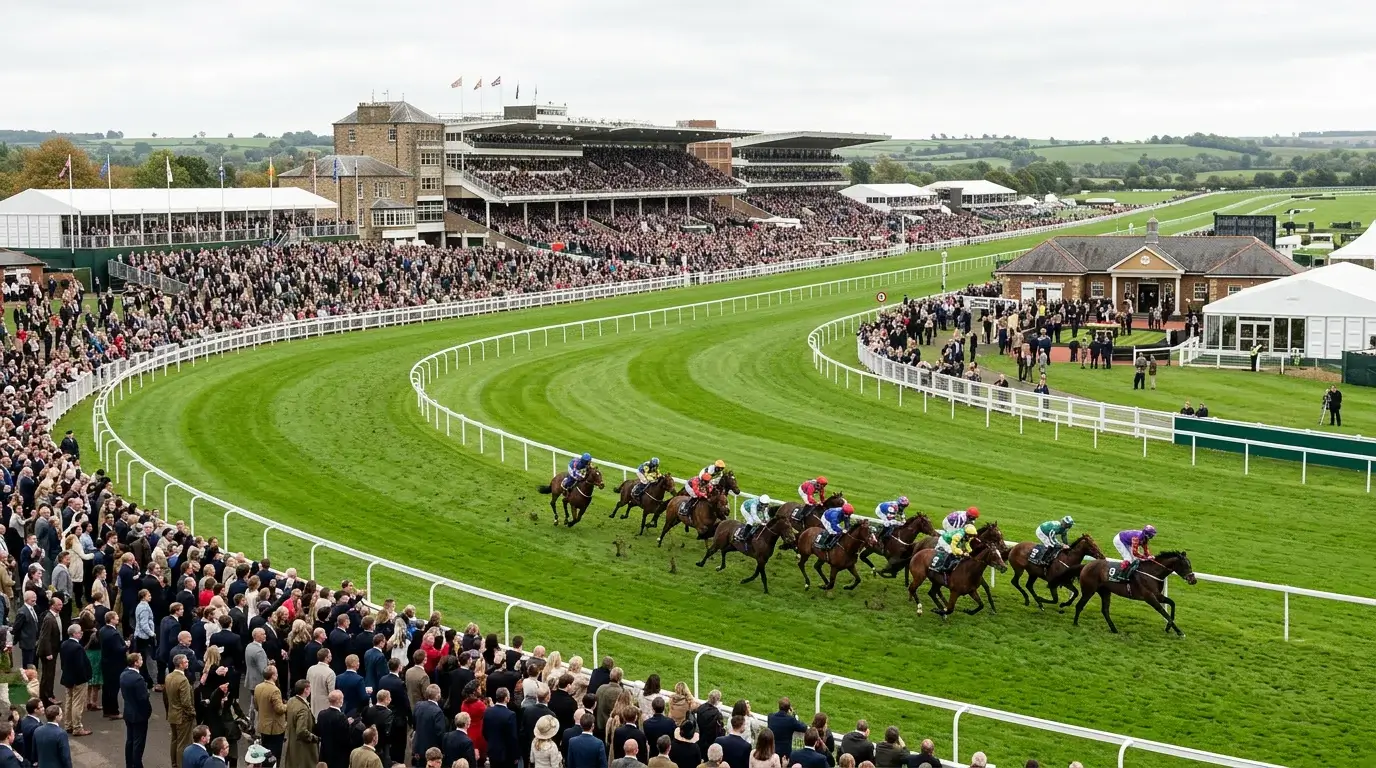
If you have ever watched a field of fourteen horses thunder down the straight at Newmarket and wondered how a four-year-old carrying nine stone two can finish ahead of a five-year-old lumping ten stone, the answer sits inside a single number: the BHA Official Rating. That number, updated every Tuesday by a team of eleven full-time handicappers, determines the weight each horse must carry and, by extension, the competitive balance of roughly sixty per cent of all races staged in Britain. Handicap races are not a niche — they are the backbone of British racing, the format that fills fields, drives betting turnover and keeps the sport financially viable from Musselburgh to Market Rasen.
Horse racing in the United Kingdom is the second-largest spectator sport after football, supporting approximately 85,000 jobs and contributing billions to the economy each year. The sport's economic engine does not run on Group 1 glory alone — it runs on the six-furlong Class 5 handicap at Wolverhampton on a Wednesday afternoon, the sixteen-runner Cesarewitch, and every competitive Saturday afternoon card where bookmakers and punters trade opinions translated into pounds and pence. Understanding how handicapping works is not optional for anyone who takes betting seriously. It is the operating system behind the sport.
This guide exists to make that operating system legible. We will walk through how BHA ratings are assigned, how those ratings convert to raceday weight, what the seven-tier class structure means for competition quality, and how to identify horses whose ability exceeds their official mark — the handicapper's edge that separates profitable punters from casual ones. Along the way, we will use real data from the BHA's own publications, academic research, and industry statistics that most guides in this space ignore entirely. Whether you are reading your first racecard or building your own ratings model, the framework starts here.
A note on scope: this is a UK-focused guide. The British Horseracing Authority oversees the handicapping system that governs all Flat and National Hunt racing in Great Britain. Ireland operates a separate but closely aligned system under the IHRB, and the American model is structurally different again. We will touch on those comparisons later, but the core of what follows applies to any race run under BHA rules — which, in the spring of 2026, means around 1,500 fixtures and over 10,000 individual races per year.
What You'll Learn About UK Handicapping, Ratings and Betting Edges
- BHA Official Ratings, maintained by eleven handicappers and updated weekly, translate directly into raceday weight at one rating point per pound — the foundation of every handicap bet you will ever place.
- Around sixty per cent of British races are handicaps, generating the bulk of betting turnover from a market worth over £766 million in annual gross gambling yield.
- In a typical handicap field, only two or three horses outperform their rating — learning to identify these well-handicapped runners is the single most valuable analytical skill a punter can develop.
- Data from fifteen-plus years of UK racing shows the top three horses by weight produce approximately 37% of all winners, making weight analysis a sharper tool than most punters assume.
- This guide covers BHA ratings, weight mechanics, class structure, racecard reading, a five-step evaluation framework, betting strategies and the tools to build your own edge — with verified statistics throughout.
BHA Official Ratings: How Every Horse Gets a Number
Every horse that races under BHA rules eventually receives a number. That number — the Official Rating, abbreviated to OR — represents the handicapper's assessment of a horse's ability relative to every other rated horse in Britain. A Class 7 sprinter might sit on an OR of 50. A top-class miler could carry a mark of 115. Frankel, the highest-rated Flat horse in BHA history, peaked at 140 — a figure so far above the average that it belongs more to statistical mythology than to practical handicapping. For the rest of the population, the rating is where strategy begins.

The system is governed by a team of eleven full-time handicappers employed by the BHA, each responsible for specific divisions of the racing programme. Their job is deceptively simple in description and extraordinarily difficult in practice: watch every race, assess every performance, and decide whether a horse should go up, down, or stay the same. New ratings are published every Tuesday, ahead of the following week's declarations. The cycle is relentless. A horse that wins a competitive handicap on Saturday will have its new mark confirmed within days, altering the landscape for every race it enters thereafter.
"The handicap rating given to any horse is somebody's opinion," notes professional punter Steve Lewis Hamilton in his Racing Masterclass. "Granted, it is based upon evidence, but nonetheless it is the official handicapper who allocates a horse their BHA rating." That distinction matters more than it might appear. An opinion, however expert, contains margin for error — and that margin is exactly where the handicapper's edge lives for bettors willing to do their homework.
A horse does not receive an OR immediately. Under BHA rules, a horse must complete at least three qualifying runs before the handicapper assigns an initial mark. Those three runs give the team enough data to form an evidence-based view, but they also create information asymmetry: a trainer who has worked a horse at home knows more about its true ability than any rating based on three public performances can capture. The transition from unrated to rated is one of the most fertile hunting grounds in British racing, and we will return to it in the step-by-step framework later in this guide.
One rating point equals one pound of weight. This 1:1 conversion is the mathematical spine of the entire handicapping system. If Horse A is rated 95 and Horse B is rated 90, the handicapper's model assumes that five additional pounds in the saddle will bring them to parity. In theory, every horse in a perfectly handicapped race should cross the finish line together. In practice, of course, they do not — and research from the BHA's own data suggests that in a typical field of eleven to thirteen runners, only two or three horses will outperform their official mark on any given day. The challenge is identifying which two or three.
The BHA Official Rating is an opinion backed by evidence, not an absolute truth. Every rating contains a margin of error — and that margin is the space in which informed punters find value.
From Rating to Raceday: How Handicap Weights Are Set
Once the handicapper has set the ratings, the weight sheet follows with mechanical predictability. The race conditions specify a top weight — typically ten stone in a standard Flat handicap — and the highest-rated horse in the field is assigned that figure. Every other runner's weight is calculated by subtracting the difference in rating points, pound for pound, from the top weight. If the top-rated horse carries ten stone at an OR of 100, a horse rated 88 will carry nine stone two. The arithmetic is clean, and it is the same whether the race is a Class 2 at Ascot or a Class 6 at Catterick.
Handicap Weight Calculator
Turn a BHA Official Rating into raceday weight — 1 point = 1 pound
The whole handicap system runs on one rule: one rating point equals one pound. Set the race's top weight and top rating, then enter your horse's mark to see exactly what it carries — with penalties, apprentice claims and the 8st floor all handled.
Where it gets interesting is in the gaps. The BHA sets minimum weights for safety reasons — no horse on the Flat can carry less than eight stone — which means that in races with a wide spread of ratings, the lowest-rated runners may end up carrying more than the formula would dictate. These horses are said to be running "out of the handicap," receiving no weight advantage relative to their official mark. Whether that represents dead weight or a genuine disadvantage is a question we will address later, but the mechanical point is straightforward: the weight sheet is a direct translation of the rating hierarchy, capped at the top and floored at the bottom.
Frankel's Official Rating of 140 would have required him to concede over 50 pounds to an average Class 5 handicapper rated in the mid-80s — roughly the equivalent of strapping a full set of luggage to the saddle. It is precisely why horses of that calibre never run in handicaps.
Penalties complicate the picture. A horse that wins a race after the weights have been published but before it runs in its next handicap will carry a penalty — usually five to seven pounds — on top of its allotted weight. The penalty exists because the handicapper has not yet had time to reassess the horse's rating. This creates a known inefficiency: penalty runs carry inflated weight that may or may not reflect the horse's true improvement. The data on this inefficiency is revealing, and we will examine it in detail when we discuss well-handicapped runners and trainer tactics.
Allowances work in reverse. Apprentice jockeys on the Flat and conditional jockeys over jumps are permitted to claim weight off the horse's allocated burden — typically three, five, or seven pounds depending on the jockey's career win count. A seven-pound claim from a talented apprentice is not a trivial adjustment; it is the equivalent of a seven-point rating swing in the horse's favour. Shrewd trainers use claiming jockeys strategically, placing them on horses that are borderline competitive on the figures, where the weight reduction tips the balance.
The weight sheet, then, is not just a list of numbers. It is a map of relative ability, adjusted for recency, distorted by penalties, and open to manipulation through jockey selection. Reading it properly is the first practical skill a handicap bettor needs to develop.
Class 1 to Class 7: Understanding the UK Racing Ladder
British racing organises its programme into seven numbered classes, from Class 1 at the pinnacle down to Class 7 at the entry level. Each class corresponds to a band of Official Ratings, and the boundaries matter because they determine which horses are eligible to run in which races, what level of prize money is on offer, and — critically for bettors — how competitive the field is likely to be. A horse rated 85 can enter a Class 3 handicap but would be ineligible for a Class 5 restricted to ratings of 0–70. The class system gates access, and understanding it is fundamental to reading the racing programme.
Class 1 covers the elite tier: Group races, Listed races and the highest-value handicaps such as the Cambridgeshire and the Cesarewitch. Class 2 sits immediately below, featuring valuable handicaps that regularly attract fields of sixteen or more on high-profile Saturday cards. Classes 3 and 4 form the bulk of competitive racing at major tracks, while Classes 5 through 7 occupy the bread-and-butter programme at smaller and all-weather venues. The prize money gradient is steep — a Class 1 handicap at Royal Ascot might offer a purse twenty times larger than a Class 7 at Southwell.
For handicap bettors, the class structure creates a specific type of opportunity: the class drop. When a horse that has been competing at Class 3 level drops into a Class 4 race — perhaps because its rating has slipped after a string of moderate performances — it may find itself among weaker opposition while retaining the latent ability that earned its higher mark. The trainer, meanwhile, has waited for the right moment to strike. Class drops are not a guaranteed edge, but they are a well-documented one, and the racecard tells you exactly when they are happening if you know where to look.
Field sizes vary considerably by class and meeting type. Data from the BHA's Q3 2025 Racing Report shows that Premier Flat meetings averaged 10.97 runners per race — a figure approaching the ideal for competitive handicap betting — while Core Jump meetings averaged just 7.63. The gap between Premier and Core has widened in recent years, a trend driven in part by the declining horse population and fixture congestion. Smaller fields compress the market, reduce each-way value, and make favourites harder to oppose. For punters focused on handicaps, filtering by meeting tier is not a luxury — it is a baseline requirement.
| Class | Typical OR Range | Race Types | Typical Field Character |
|---|---|---|---|
| 1 | 100+ | Group, Listed, Heritage Handicaps | Elite, highly competitive |
| 2 | 86–105 | Valuable handicaps, conditions stakes | Strong fields, 12–20 runners common |
| 3 | 76–95 | Mid-range handicaps at major tracks | Competitive, solid depth |
| 4 | 66–85 | Standard handicaps, some heritage races | Broad rating spread |
| 5 | 56–75 | Lower handicaps, all-weather regulars | Mixed ability, exposed form |
| 6 | 46–65 | Entry-level handicaps | Often smaller fields |
| 7 | 46–55 | Lowest-tier handicaps | Restricted, modest quality |
The rating bands overlap deliberately. A horse rated 76 is eligible for both Class 3 and Class 4 races, giving trainers flexibility in where they campaign. That flexibility is the mechanism through which class drops — and class rises — become strategic tools rather than mere administrative details.
The Well-Handicapped Horse: What It Means and Why It Matters
A horse is described as "well handicapped" when its true ability exceeds its Official Rating. The phrase sounds simple, but it sits at the centre of almost every profitable handicap strategy. If the BHA handicapper has assessed a horse at 85 and it is genuinely capable of running to a mark of 92, that horse is carrying less weight than its talent warrants. In a system where one rating point equals one pound, being seven pounds well-in is a substantial advantage — the equivalent of having a length and a half head start before the stalls open.
The question, obviously, is how you identify one. The answer begins with understanding why the discrepancy exists in the first place. Ratings are backward-looking: they reflect what a horse has done, not what it is capable of doing next. A young horse on an upward curve may improve faster than the handicapper can react. A horse returning from a break may have been freshened and is sharper than its last run suggests. A horse that encountered interference, a poor draw, or unsuitable ground last time out may have run below its true level — and the handicapper, constrained by the evidence of the form book, will have lowered the rating accordingly.
BHA data supports the idea that genuine outperformers are scarce but present in every competitive field. In a typical handicap with eleven to thirteen runners, only two or three horses on average will perform above their official mark. That scarcity is what makes well-handicapped runners so valuable to bettors and so difficult for the market to price accurately. If eight out of eleven horses run to form, the winner almost certainly comes from the remaining three — and spotting those three before the market catches on is the core skill of serious handicap analysis.
There is a timing dimension too. Data from geegeez.co.uk, covering UK racing from 2008 onwards, reveals a notable split between horses that run quickly after a win under a penalty and those that wait for the handicapper to reassess. Penalty runners — those who reappear before their rating has been officially raised — show a strike rate of 23.47% but return an ROI of minus 15%. Reassessed runners win at 16.98% with a slightly better ROI of minus 13.5%. The penalty runners win more often because many are genuinely well-handicapped at their old mark, but the market knows it too, compressing their odds to the point where the value evaporates. The real skill, in this case, is not just finding the well-handicapped horse — it is finding the one the market has underestimated.
Well-handicapped horses exist in every race, but the market prices the obvious ones efficiently. The edge lies in identifying outperformers whose improvement is masked by excusable form — bad ground, poor draws, interrupted runs — rather than simply backing last week's winner under a penalty.
Reading a UK Racecard With Handicapping Eyes
The racecard is the single most information-dense document a handicap bettor encounters, and most people scan it too quickly. A standard UK racecard — whether printed in the Racing Post or displayed on an online form guide — packs the horse's name, age, weight, Official Rating, form figures, draw position, jockey, trainer, headgear, days since last run, and ownership details into a space smaller than a credit card receipt. Every element tells a story, and the stories interact. A horse wearing blinkers for the first time, dropping in class, and switching to a jockey who claims five pounds is sending a very different signal from one plodding along in the same headgear at the same track it lost at three weeks ago.

Form figures are displayed in chronological order, with the most recent run on the right. A sequence of 213-4 tells you the horse finished second, then first, then third in one season, followed by a fourth-place finish in the current campaign — the hyphen denoting a new season. A zero means unplaced outside the first nine. Letters carry specific meaning: F for fell, U for unseated, P for pulled up, R for refused. In handicap analysis, the numbers matter less than the context behind them. A horse that finished fourth of six in a Class 2 may have run a stronger race than one that won a Class 6 against three rivals. The form figure says "4"; the analysis says "this horse is better than it looks."
Headgear codes deserve particular attention. A "b" means blinkers, "v" is a visor, "t" denotes a tongue tie, "p" means cheekpieces, and "h" stands for a hood. When you see a small "1" superscript next to a headgear code, it signals first-time application — often a deliberate move by the trainer to sharpen up a horse that has been racing lazily. First-time headgear combined with a positive jockey booking can indicate intent. It is not a guarantee of a win, but it is a data point that serious handicappers weight heavily.
The draw column is relevant only on flat courses with straight-track races, where stall position can confer a genuine advantage or disadvantage. At Chester, low draws dominate over five furlongs. At Beverley, high draws can be golden. The racecard gives you the draw number; the analysis requires you to know whether that number matters at this course, at this distance, on this going. We will return to draw bias in the step-by-step framework, but for now the principle is simple: never ignore the draw in a straight-course sprint handicap.
Finally, scan the weight column alongside the OR column. If a horse is listed at nine stone seven but its official rating is 82, and another horse carries nine stone seven at an OR of 85, the first horse is receiving three pounds less than its rating difference would normally dictate — probably because it is carrying a penalty or the race conditions compress the weights. These small discrepancies, invisible to casual racegoers, are where the racecard starts talking to you in the language of edges.
A Five-Step Framework for Evaluating Any UK Handicap
Theory is necessary. A repeatable process is better. What follows is a five-step framework for evaluating any UK handicap race — systematic enough to impose discipline, flexible enough for live racing.
Step 1: Assess the race conditions. Before examining a single horse, assess the race itself. What class? How many runners? A twelve-runner Class 3 at Newbury on good ground is a fundamentally different proposition from a six-runner Class 6 at Wolverhampton on standard all-weather. Field size determines market liquidity, each-way terms, and the probability of a true-run race. As Jim Mullen, Group Chief Executive of The Jockey Club, has noted, racing attracts millions of participants — but their bets cluster around specific conditions, creating sharper markets in well-attended Saturday handicaps and softer ones midweek.
Step 2: Filter by weight and rating. The BHA's one-point-one-pound system gives you a built-in ranking of the field, but the ranking is only as good as the most recent reassessment. Identify which horses are carrying penalties versus reassessed marks. Check whether any horse is running out of the handicap — carrying the minimum weight with a rating below the race floor. The data from geegeez.co.uk shows that the top three horses by weight account for approximately 37% of all handicap winners, a figure that challenges the popular assumption that top weight is a death sentence. Weight is a burden, but it is also a proxy for ability, and the best horse in the race very often carries the most weight.

Step 3: Read the form in context. Ignore the bare form figures and focus on circumstances. Was the ground suitable? Was the distance right? Did the jockey report trouble? A horse that finished sixth of sixteen in a Class 2 at Ascot on soft ground — with a 0-for-5 record on soft — has told you nothing about its ability on good ground in a Class 3. Form analysis is pattern recognition: you are looking for the run that represents the horse's true level, not its most recent one.
Step 4: Evaluate the connections. Trainer intent is the most underrated variable. Has a more expensive jockey been engaged? Check the trainer's strike rate with relevant horse types: first-time handicap runners, class droppers, quick reappearances. A trainer who normally spaces runs three weeks apart suddenly entering one after six days is making a statement.
Step 5: Check the market and the going. The betting market aggregates the opinions of thousands of participants, some of whom have access to private information, stable gossip, and gallop reports. Significant market moves — particularly late-morning shortening on the exchanges — can confirm or contradict your own analysis. The going, confirmed by the clerk of the course on the morning of the race, is the final variable. Ground conditions in spring 2026 have been unpredictable across much of the UK, and the difference between good-to-firm and good-to-soft can reshape the contenders entirely. Always check the going report as close to race time as possible.
One additional scheduling note that affects race quality: the BHA has worked to reduce Saturday afternoon fixture clashes, bringing the collision rate down from 11.1% in 2022 to just 5.8% in 2024. Fewer clashes mean fuller fields and deeper betting pools on the day that matters most for turnover — a structural improvement that benefits both the sport and the punter looking for well-populated handicaps.
The framework above structures your thinking. The next section translates that structure into specific betting strategies — because finding the right horse is only half the challenge.
Betting Strategies That Work in Handicap Races
Handicap races are where serious bettors make their living, and there is a structural reason for that. The Gambling Commission's latest industry data records gross gambling yield from remote horse racing bets at £766.7 million for the financial year ending March 2025. With roughly sixty per cent of all British races being handicaps, the format generates the lion's share of that yield — large fields, competitive markets, and information asymmetry create the conditions in which value bets can exist. In non-handicap racing — Group races, Listed events, maidens — the form is usually transparent and the market is efficient. In a sixteen-runner Class 3 handicap, efficiency breaks down, and that breakdown is your opportunity.
Value identification. The concept is simple: a horse whose true chance of winning exceeds the probability implied by its odds represents a positive expected-value bet. In practice, this requires the form analysis described earlier combined with honest self-assessment. A useful heuristic: if you can articulate three specific, data-grounded reasons why a horse should outperform its rating, you have a candidate worth pricing. If you cannot, move on.
Each-way betting in big-field handicaps. Each-way betting becomes mathematically attractive when field sizes push bookmakers into offering enhanced place terms. In races with sixteen or more runners, standard terms pay out on the first four places at a quarter of the win odds. At some bookmakers, races with twenty or more runners extend to five places or better. The BHA's Q3 2025 field-size data shows Premier Flat meetings averaging 10.97 runners — meaning many Saturday handicaps comfortably exceed the sixteen-runner threshold. The each-way strategy is not about finding the winner. It is about finding a horse at 14/1 or longer that has a genuine chance of finishing in the first four, where the place part of the bet returns profit even if the win part loses.
Weight-range analysis. Rather than instinctively opposing the top weight, consider the weight range in context. A narrow spread — say, twelve pounds from top to bottom — means the handicapper sees the field as closely matched and the top weight is not conceding much. A wide spread of twenty-five pounds or more suggests the top weight faces a stiffer challenge from lightweights at the bottom of the handicap. The data-driven approach is to filter for handicaps where the weight range compresses, because those races tend to be more formful and therefore more predictable for bettors who have done their analysis.
Seasonal and market timing. The online betting market for horse racing shows clear seasonal patterns. The Gambling Commission's operator data for Q4 of the financial year — January to March 2025, covering the Cheltenham Festival window — showed a five per cent year-on-year increase in real-event betting GGY, pushed upward by what the regulator described as bookmaker-friendly festival results. That seasonal pulse matters for bettors: the market is deepest, the fields are strongest, and the information ecosystem is richest during festival periods and high-profile Saturday cards. Betting into thin midweek markets, where a single large stake can move the price, carries different risks.
The most reliable handicap betting strategies combine form analysis with structural awareness — each-way edges in big fields, weight-range filters, and seasonal timing. The edge is not a single trick; it is a process applied consistently across hundreds of races.
Seven Mistakes Punters Make in Handicap Betting
Handicap betting attracts more money and opinions than any other form of horse racing wagering, and the same mistakes recur with frustrating regularity.
Mistake one: ignoring the weight sheet. A surprising number of punters select horses based on form alone without examining the weight each horse carries. In a system built on weight adjustments, this is like reading a financial statement without the balance sheet.
Mistake two: assuming top weight cannot win. The data does not support this assumption. Horses in the top three by weight produce around 37% of all handicap winners in the UK. Top weight, in fact, is statistically the least unprofitable position in a handicap. The horse carries the most weight because it has the highest rating — which means, in the handicapper's assessment, it is the best horse in the race. Dismissing it reflexively is a bias, not a strategy.
Mistake three: chasing penalty runners without adjusting for odds. As noted earlier, horses running under a penalty before reassessment win at a healthy 23.47%, but at an ROI of minus 15%. The market knows about penalty runners — they are flagged in every racecard — and prices them accordingly. Backing them blindly is the handicap equivalent of buying a stock after the news is already in the price.
Mistake four: ignoring going changes. The going is declared on race morning but can shift through the card. Punters who bet the night before based on a good-ground forecast may find themselves holding tickets on horses that hate soft underfoot. Always check the going report close to race time.
Mistake five: overreacting to a single run. A horse that finishes last of sixteen has not necessarily lost its form. Traffic trouble, unsuitable ground, or an off day can all explain a poor result. One run is a data point, not a verdict.
Mistake six: betting in every race. The British racing programme in 2026 offers over 10,000 races per year. Not all of them are worth your stake. Total betting turnover on UK racing fell by 4.2% across the first nine months of 2025 compared with 2024, according to BHA data, and part of that decline reflects an increasingly selective betting public. Selectivity is a virtue, not a limitation. The best handicap bettors have a clear set of race-selection filters and are perfectly comfortable watching six races without placing a single bet.
Mistake seven: neglecting bankroll discipline. The variance in handicap betting is real and relentless. A punter with a genuine edge can still endure twenty losing bets in a row. Without a staking plan that keeps individual bets at one to two per cent of the total bankroll, a bad run wipes out the account before the edge has time to assert itself. Bankroll management is not the glamorous part of handicapping, but it is the part that keeps you in the game long enough to profit.
Tools and Data Sources for Smarter Handicapping
The difference between a casual punter and a systematic one is often reducible to data access. British racing is unusually well-served by official statistics, and any bettor serious about handicapping should know where to find them and how to use them.
BHA Monthly Data Packs. The BHA publishes monthly racing data packs in PDF format, covering runners, individual starters, runs per horse, abandonments, going distribution, and field sizes. These packs are free, publicly available on the BHA's media site, and updated on a rolling basis. For anyone building a seasonal model or tracking long-term trends in field sizes and horse population, they are the single best primary source. Yet almost no consumer-facing betting guide mentions them, which means the data is hiding in plain sight.
BHA Guide to Handicapping. The BHA's own Guide to Handicapping explains the rating process, the role of the eleven-handicapper team, and the rules governing rating changes. It is not a betting guide — it is an institutional document — but reading it gives you an understanding of the constraints the handicapper works under, which in turn helps you identify where and why ratings might lag behind reality.
Horserace Betting Levy Board reports. The HBLB Annual Report details how levy income — a record £108-109 million in 2024-25 — is collected and distributed back into racing. Understanding the levy funding mechanism helps explain why betting turnover directly affects prize money, field sizes, and the quality of the handicap programme you are betting into.
Racing Post and Timeform. The two dominant commercial providers of UK racing data offer different products at different price points. Racing Post provides racecards, form guides, Racing Post Ratings (RPR), and detailed race replays. Timeform offers its own speed-based ratings, which assess performance by time and sectional analysis rather than the collateral form approach used by the BHA. Using both alongside the official OR gives you three overlapping views of every horse — and where those views diverge, you often find value.
Exchange data. Betfair and other betting exchanges publish real-time market data that reflects the collective intelligence of the market. Significant pre-race market moves — sharp shortening in the final thirty minutes before a race — often signal informed money. Exchange data is not infallible, but it is the closest thing to a live consensus that exists in racing. Learning to read exchange movements is a skill that complements form analysis rather than replacing it.
The Benter model and academic handicapping. For those inclined toward statistical modelling, the foundational academic work remains Bolton and Benter's 1994 paper on computer-based horse race handicapping systems. Their nine-factor regression model achieved an out-of-sample explanatory power (f-squared) of 0.1016 — virtually identical to the f-squared of 0.1014 produced by aggregating the predictions of 48 newspaper tipsters. The implication is striking: a well-constructed statistical model, even one built over thirty years ago, can match the collective wisdom of dozens of experienced human analysts. Modern computing power and access to BHA data packs make replicating and extending this approach more accessible than ever.
Free BHA data packs, the official Guide to Handicapping, commercial form providers, exchange market data, and academic models — the tools for systematic handicapping are available. The constraint is not access; it is the discipline to use them consistently.
Responsible Gambling: Staying in Control on Handicap Day
Handicap betting is intellectually absorbing and potentially profitable, but it is also gambling, and gambling carries risks that no amount of form study eliminates. According to the Gambling Commission's participation survey, seven per cent of UK adults placed a bet on horse racing in the four weeks to July 2025 — a figure that rises sharply during the spring festival season. For the overwhelming majority of those bettors, racing is entertainment with an acceptable cost. For a minority, it becomes something else.
The regulatory framework in Britain is among the strongest in the world. UKGC-licensed operators are required to offer deposit limits, reality checks, session time alerts, and self-exclusion through the national GamStop scheme. These tools exist precisely because the same analytical mindset that makes handicap betting engaging — the desire to find the edge, to solve the puzzle — can also make it difficult to walk away when the bankroll says you should.
The rise of unlicensed betting sites adds a layer of risk that even disciplined punters should be aware of. Research by the IFHA Council on Anti-Illegal Betting found that visits to 22 of the most popular non-UK-licensed sites accepting bets on British racing grew by 522% between 2021 and 2024 — while licensed operators grew by just 49% over the same period. "These parasite operators don't pay tax, don't care about safer gambling, or contribute a penny to the levy," said Grainne Hurst, Chief Executive of the Betting and Gaming Council. Punters who use unlicensed sites forfeit every consumer protection that the UK regulatory system provides — no dispute resolution, no self-exclusion, no guarantee that winnings will be paid.
If you bet on handicap races, bet with licensed operators, set deposit limits before you start, and treat your bankroll as a finite resource rather than an open-ended commitment. The handicapper's edge is real, but it only works over the long term — and the long term requires you to stay in control.
Frequently Asked Questions About UK Handicap Racing
What does "well handicapped" mean and how do I spot one?
A well-handicapped horse is one whose actual ability exceeds its Official Rating, meaning it carries less weight than its talent warrants. The strongest indicators include: a horse returning from a break with evidence of physical improvement; a runner whose recent poor result has a clear excuse such as unsuitable ground, a poor draw, or in-running interference; and a young horse on an upward trajectory whose ability is still developing between runs. BHA data suggests only two or three horses outperform their mark in a typical field of eleven to thirteen — so genuine well-handicapped runners are scarce but present in every competitive race. The key is distinguishing genuinely underrated horses from those who simply won last time and are now carrying a penalty the market has already accounted for.
How are handicap weights calculated from BHA ratings?
One Official Rating point equals one pound of weight. The race conditions set a top weight — commonly ten stone on the Flat — assigned to the highest-rated horse. Every other runner carries one pound less for each rating point below. For example, if the top weight is rated 100 and carries ten stone, a horse rated 92 carries nine stone six. Two exceptions apply: the BHA enforces minimum weights (eight stone on the Flat) so bottom-rated horses may carry more than the formula dictates, and horses that have won since the weights were published carry a penalty of five to seven pounds until formal reassessment.
How do trainers legally exploit the handicap system?
Trainers have several legitimate methods for managing a horse's handicap mark. The most common is campaign management — running a horse in conditions where it is unlikely to show its best, such as over the wrong distance or on unsuitable ground, which suppresses the rating without breaking rules. When the mark reaches a favourable level, the trainer switches to optimal conditions. Another approach involves quick re-entry after a win under a small penalty before the handicapper raises the rating. Data from geegeez.co.uk shows penalty runners win at 23.47%, though the ROI of minus 15% indicates the market recognises the tactic. Seasonal planning is also widespread, particularly with jumps trainers peaking horses for spring festivals after quiet autumn campaigns. None of these methods breach integrity rules, but they create information asymmetry that alert punters can learn to read.
UK Handicapping Glossary: A–Z Quick Reference
Allowance — a weight reduction claimed by an apprentice or conditional jockey, ranging from 3lb to 7lb depending on career wins.
Class drop — when a horse moves from a higher class to a lower one, often signalling an attempt by the trainer to find easier opposition.
Draw — the stall number from which a horse starts in a Flat race. At certain courses, specific positions carry a statistical advantage.
Each-way — a bet comprising two equal stakes: one on the horse to win, one to place. Place terms vary by field size.
Form figures — a shorthand sequence of finishing positions from recent races, displayed chronologically with the most recent run on the right. A "1" means a win; "0" means unplaced outside the first nine.
Going — the condition of the racing surface, from firm (driest) to heavy (wettest) on turf, or standard to slow on all-weather.
GGY — Gross Gambling Yield. The amount retained by bookmakers after paying out winnings.
Handicap mark — another term for Official Rating when used in the context of a handicap race.
Long handicap — a theoretical extension of the weight sheet below the race minimum. A horse in the long handicap runs "out of the handicap."
Official Rating (OR) — the BHA-assigned ability figure, updated weekly. One point equals one pound of weight.
Penalty — additional weight (typically 5–7lb) carried by a horse that has won since the weights were published.
Strike rate — the percentage of wins from total runs for a horse, jockey, or trainer.
Top weight — the horse carrying the most weight in a handicap, corresponding to the highest Official Rating in the field.
Weight-for-age (WFA) — a scale adjusting weights for younger horses competing against older rivals, originally devised by Admiral Rous in 1855.
Well handicapped — a horse whose true ability exceeds its Official Rating, carrying less weight than its talent warrants.
