
Trainer Tactics in UK Handicap Racing: How Professionals Legally Exploit the BHA System
Best Greyhound Betting Sites – Bet on Greyhounds in 2026
Loading...
Why Some Horses Win “On Cue” — and What the Trainer Already Knew
There is a particular type of handicap result that makes experienced punters lean forward in their seats. A horse that has run four times without threatening the first three, each time in conditions that looked wrong — too short a trip, unsuitable ground, a jockey who didn’t push — suddenly appears at a different course, over a different distance, on ground it relishes, ridden by the stable’s retained rider. It wins by three lengths at 12/1, and the Racing Post comment reads “always travelling well, led two out, never in doubt.” The trainer gives a post-race interview that amounts to: “We always thought he was well handicapped.”
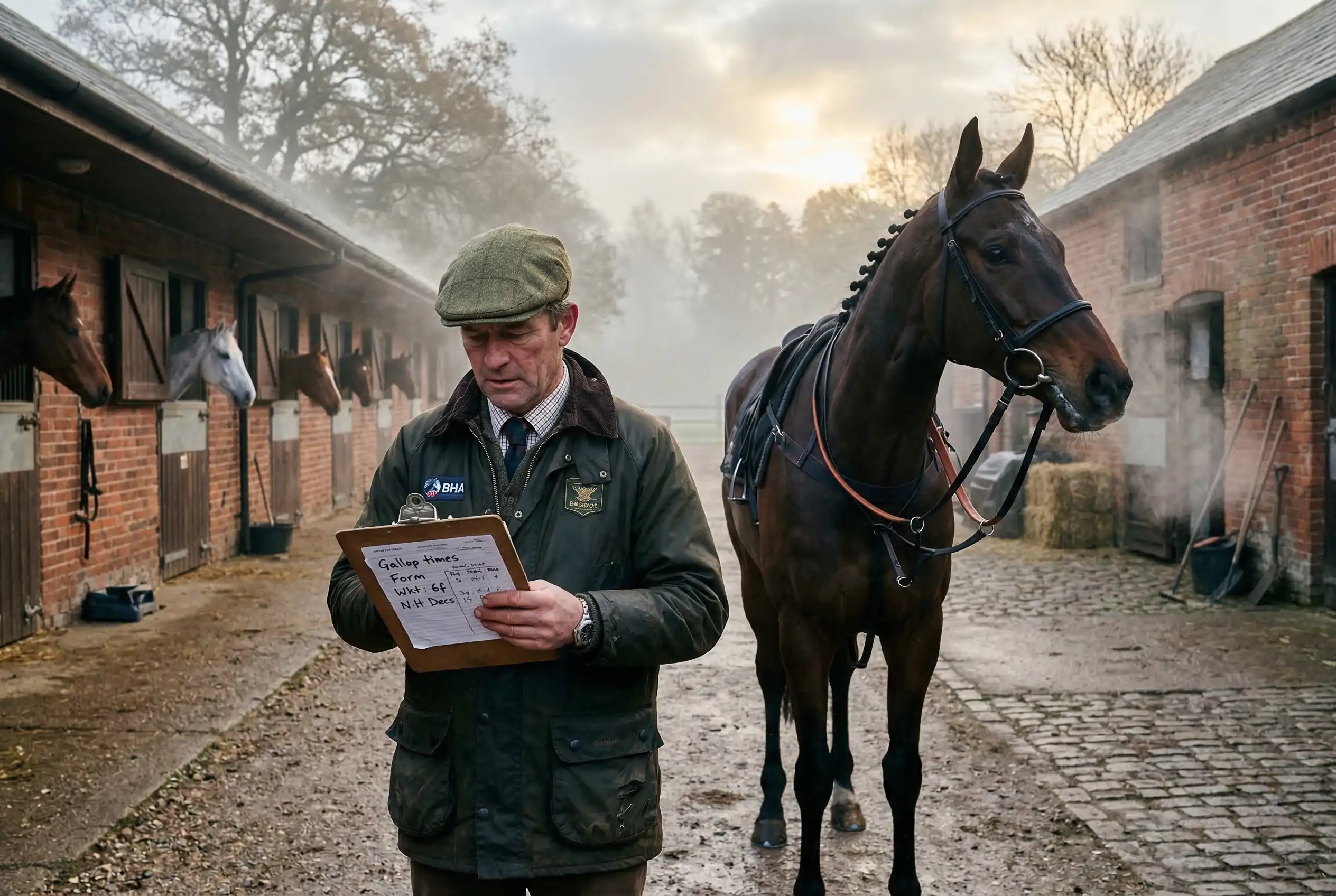
This is not corruption. It is not even deception, strictly speaking. It is campaign management — the art of placing a horse in conditions where its Official Rating will not rise, or might even fall, so that when optimal conditions are finally selected, the horse competes off a mark that underestimates its true ability. It is the trainer’s playbook, and reading it is one of the most valuable skills a handicap bettor can develop.
The BHA handicapping system is built on evidence. A team of eleven handicappers assesses every performance and adjusts ratings every Tuesday based on what happened on the racecourse. But the system can only rate what it sees — and trainers control, to a significant extent, what the handicapper is shown. A horse that runs over the wrong trip on the wrong ground is showing the handicapper a suppressed version of its ability, and the rating will reflect that suppressed version. The trainer knows more than the rating reveals. The punter who can read the trainer’s intent has access to the same informational edge.
The data confirms that this dynamic is real. Analysis of UK racing from 2008 onwards, published by geegeez.co.uk, shows that horses running quickly under a penalty after a win — before the handicapper has time to reassess — achieve a strike rate of 23.47 per cent, but at a negative return on investment of minus 15 per cent. The market knows about these horses and prices them accordingly. The more interesting opportunities lie elsewhere: in horses whose ratings have been quietly managed downward over a series of runs, and whose connections are now signalling that the campaign is about to pay off.
Penalty Runs vs Re-Assessed Runs: What the Numbers Say
The distinction between a penalty run and a reassessed run is the first piece of tactical literacy a handicap bettor needs. When a horse wins a race, the BHA handicapper will reassess its rating — but ratings are only published on Tuesdays, and the racing week runs from Sunday to Saturday. If a trainer enters the horse again before the new rating is published, the horse runs off its old mark plus a fixed penalty: six pounds for a two- or three-year-old on the Flat, five pounds for a four- to six-year-old, and seven pounds over jumps. The penalty is a blunt instrument — it may overestimate or underestimate the handicapper’s eventual reassessment.
The data on this split is revealing. Geegeez.co.uk, analysing UK racing results from 2008 onward, found that horses re-entered quickly under a penalty won 138 of 588 subsequent starts — a strike rate of 23.47 per cent. That is a high win rate by any standard; in an average handicap, you would expect a win rate of between seven and ten per cent for a randomly selected runner. But the return on investment for these penalty runners was minus 15 per cent, meaning that backing every one of them to level stakes would have lost you fifteen pence in the pound over the dataset.
Contrast that with horses whose ratings had been formally reassessed before their next run. These runners won 3,461 of 20,380 starts — a strike rate of 16.98 per cent — with a slightly better ROI of minus 13.5 per cent. They win less often, but the market overestimates penalty runners and underestimates some reassessed runners, creating a pricing asymmetry that alert bettors can exploit.
Why does this asymmetry exist? Penalty runners are visible. Every racecard flags them. Newspaper tipsters love them — “won last time, races again before the handicapper can catch up” is a compelling narrative. The betting public piles in, compressing the odds to the point where the value evaporates. A horse that deserves to be 5/1 based on its true chance ends up 7/2 because the market is pricing the recent win rather than the adjusted probability.
“The handicap rating given to any horse is somebody’s opinion,” observes professional punter Steve Lewis Hamilton in his Racing Masterclass. “Granted, it is based upon evidence, but nonetheless it is the official handicapper who allocates a horse their BHA rating.” That subjectivity — eleven handicappers making judgement calls every Tuesday — is the gap through which trainers operate. A rating is an informed estimate, not a measurement. And when the evidence on which the estimate is based has been shaped by strategic campaigning, the estimate is only as good as the data it rests on.
The practical takeaway is straightforward. Do not back penalty runners on autopilot. The 23.47 per cent strike rate looks attractive, but at minus 15 per cent ROI, the market has already extracted the edge. Instead, look for horses whose assessments have been quietly managed — where the handicapper’s Tuesday opinion lags behind the trainer’s private knowledge. That lag is where the value sits, and reading the trainer’s playbook is the method for finding it.
The “Wrong Trip” Playbook: Mark Prescott and Strategic Campaigning
If there is one name synonymous with the art of handicap exploitation in British racing, it is Sir Mark Prescott. Operating from his yard at Heath House in Newmarket — a training establishment with a lineage stretching back to the 1880s — Prescott has built a reputation as the most patient and methodical campaign manager in the weighing room. His method is deceptively simple: run a horse in conditions where it cannot show its best, let the handicap mark fall, then switch to optimal conditions and watch it win at a price that reflects the mark, not the ability.
The “wrong trip” is the most common tool in this playbook. A trainer who knows that a horse’s ideal distance is a mile and a half might enter it over six furlongs or a mile for its first few starts. The horse, unable to use its stamina, finishes mid-division. The handicapper, who can only rate what he observes, assigns a moderate mark based on those moderate performances. The trainer then enters the horse over the correct distance, often on its preferred ground, and the transformation is dramatic. The horse that looked ordinary over a mile suddenly wins easily over a mile and a half — not because it improved overnight, but because it was always better than its rating suggested.
Prescott’s mastery lies not just in the tactic but in the discipline with which he executes it. His horses typically run in sequences that are carefully plotted months in advance. A two-year-old might be given three qualifying runs over a sprint trip in the autumn, picking up a modest initial rating. It returns the following spring — heavier, stronger, more mature — and campaigns over a middle distance. The handicapper does not know what the horse can do over the longer trip because it has never been tried. The trainer does, because he has seen it work at home. By the time the public sees the ability, the trainer has already placed his bets.
The wrong-trip approach extends beyond distance. Ground conditions are equally exploitable. A horse bred for soft ground can be run on firm in the summer, finishing behind rivals that handle the quicker surface. Its rating drops. When the autumn rains arrive and the going turns soft, the same horse is suddenly competitive off a lower mark. The form book shows recent failure; the reality is a horse in its element. Similarly, running a horse at a course that does not suit its running style — a hold-up horse at a tight, front-runner-friendly track, for example — can suppress form without raising integrity concerns.
Is this fair? The BHA says yes, provided the horse is given a genuine chance to run on its merits in each individual race. The rules of racing require that every horse is run to achieve its best possible placing — trainers cannot instruct jockeys to lose deliberately. But “best possible placing” in conditions that do not suit is still a suppressed performance, and the handicap system cannot distinguish between a horse that ran poorly because it was not good enough and one that ran poorly because the conditions were wrong. That information gap is the trainer’s edge, and Prescott, more than any other trainer in modern British racing, has made a career of exploiting it.
Seasonal Patterns: Running to Lose Before Running to Win
The British racing calendar is not a single continuous season — it is a layered programme of Flat turf, all-weather, and National Hunt racing, each with its own rhythm, its own peaks, and its own opportunities for strategic timing. Shrewd trainers map their campaigns around these seasonal structures, using quieter periods to suppress ratings and busier periods to cash in.
The most common seasonal pattern in jump racing runs like this: a horse returns from its summer break in October or November, when the ground is often less testing than it will become in midwinter. It has two or three runs over hurdles or fences, finishing mid-field in moderate handicaps. The going might be good-to-soft when the horse prefers heavy. The trip might be slightly short of its optimum. Each run produces a performance figure that does nothing to alarm the handicapper. The rating drifts downward, or at best holds steady.
Then comes January, February, or March. The ground has turned heavy. The big meetings — Cheltenham Trials day, the Festival itself, Aintree — are approaching. The trainer enters the horse in a competitive handicap over its ideal trip, on its preferred going, with a jockey who knows the horse and has instructions to ride to win. The mark is five or six pounds lower than the horse’s true ability warrants. It wins, or at least runs a major race, and the racecard tells a story of sudden improvement. The reality is a plan months in the making.
On the Flat, the equivalent pattern often involves the all-weather season as a staging ground. A trainer may give a horse three or four runs on Polytrack or Tapeta through the winter, knowing the horse is a turf specialist that does not handle the kickback or the uniform surface. The rating adjusts downward. When the turf season begins in late March and April, the horse appears in a handicap on its preferred surface, freshened and sharper, off a mark that reflects its all-weather form rather than its turf potential. The improvement looks sudden. It was always the plan.
The spring of 2026 offers a live example of these dynamics in action. The Flat turf season opened in late March with a programme designed to attract large fields at Premier venues, while the all-weather continued in parallel. Trainers who spent the winter running their turf-specialist handicappers on artificial surfaces are now switching them to grass — often at lower marks than they carried twelve months ago, on ground that suits, with jockey bookings that signal intent. The seasonal transition is the moment the plan crystallises, and the form book from October to March is the map that tells you where to look.
With approximately sixty per cent of all UK races being handicaps, the volume of opportunity for this kind of seasonal campaigning is enormous. The BHA handicapping team is not naive to these tactics — they watch race replays, read sectional times, and adjust for known biases. But the system is constrained by its own rules: a handicapper can only rate what happened, not what might have happened if the horse had been running under different conditions. The trainer’s seasonal calendar is a strategic document, and the punter who can read it alongside the racecard has a genuine information advantage.
Punter’s Radar: Signals That a Trainer Is Ready to Strike
Knowing that trainers manage campaigns is one thing. Identifying the moment they intend to cash in is another. There are several signals — none individually conclusive, but collectively persuasive — that suggest a horse is about to run to its true ability rather than fulfilling a role in a longer-term plan.
The jockey booking is the loudest signal. If a trainer who has been using a claiming apprentice or a less experienced rider suddenly books a top jockey — or the stable’s retained rider — for a horse that has been quietly underperforming, the switch carries meaning. Jockeys are expensive, and trainers do not engage Ryan Moore or William Buick for a horse they expect to finish seventh. The booking says the connections believe the horse can win, and they want the best available rider to deliver that outcome.
First-time headgear is the second signal. When a horse that has been running freely without blinkers, a visor, or cheekpieces suddenly appears with headgear applied for the first time, the racecard is telling you the trainer has made a tactical adjustment to sharpen the horse’s concentration. First-time blinkers, in particular, are a well-documented angle — a deliberate intervention that often coincides with a day the trainer means business. Combined with a jockey switch, it is a strong indication of intent.
The drop in class provides structural context. A horse that has been competing at Class 3 level, producing mid-division finishes that have gradually eroded its mark, suddenly enters a Class 4 or Class 5 handicap. The opposition is weaker. The prize money is lower. But the reduced competition means the horse, now racing off a suppressed mark, faces rivals it should comfortably outclass. The trainer has waited for the mark to drop, selected a race where the horse has every chance, and paired it with the right jockey and headgear.
Quick re-entry after a break tells a different story. A horse that has been absent for two or three months and reappears at a specific meeting — particularly a Saturday Premier card or a festival handicap — has likely been targeted at that race. Trainers do not bring horses back from a break casually. If a horse has been freshened over the summer and its first run back is in a valuable autumn handicap on soft ground, the trainer has chosen that race because the conditions align with the horse’s profile, and the expected return justifies the preparation.
BHA data consistently shows that in a typical handicap field of eleven to thirteen runners, only two or three horses on average will perform above their official mark. The trainer’s job is to ensure his horse is one of those two or three. The punter’s job is to recognise the signals that the campaign has reached its intended climax — not through inside information, which is illegal, but through reading the publicly available evidence with the same strategic eye the trainer uses to plan it.
Where Legal Tactics End and Integrity Rules Begin
The tactics described in this article are legal. That statement deserves emphasis, because the language of campaign management — “suppressing a mark,” “running over the wrong trip,” “managing the handicapper” — sounds perilously close to the language of cheating. The distinction rests on a fundamental principle of BHA integrity rules: every horse must be run on its merits in every race. A trainer may select conditions that are unlikely to produce the horse’s best performance, but once the horse is in the race, both trainer and jockey are required to ensure it achieves the best finishing position it can.
The BHA’s integrity department, supported by stewards at every racecourse, monitors for breaches of this rule. Jockeys who fail to ride out to the finish, trainers whose horses show inexplicably inconsistent form, and unusual betting patterns that might indicate pre-arranged outcomes all attract scrutiny. The penalties for proven non-triers are severe: fines, suspensions, loss of licence, and criminal prosecution in extreme cases. The integrity framework is not cosmetic — it is rigorously enforced, and the number of successful prosecutions in recent years demonstrates that the BHA takes it seriously.
The line between campaign management and non-trying is this: a trainer may choose which races to enter, at which distance, on which ground, with which jockey. These are legitimate strategic decisions. What a trainer may not do is instruct a jockey to deliberately lose, stop a horse from running to its ability during a race, or withhold effort in a manner designed to deceive the handicapper or the betting public. The choice of conditions is the trainer’s prerogative; the running of the race is governed by rules that demand genuine effort.
The broader integrity landscape adds context. Research by the IFHA Council on Anti-Illegal Betting found that visits to unlicensed betting sites taking bets on British racing grew by 522 per cent between 2021 and 2024. The growth of unregulated betting introduces risks that go beyond consumer protection — it creates markets where manipulation is harder to detect, where suspicious betting patterns cannot be monitored by the BHA’s integrity unit, and where the financial incentives for corrupt activity are amplified by the absence of oversight.
For punters, the integrity framework is both a constraint and a comfort. It constrains because the most blatant forms of exploitation — instructing a horse to lose — are policed and punished. It comforts because the existence of strong integrity rules means that the legal tactics described in this article — campaign management, wrong-trip selections, seasonal timing — are genuinely the extent of what trainers can do. The playbook has boundaries. Reading the trainer’s playbook means understanding both the strategies they employ and the lines they cannot cross.