
How to Read a UK Racecard: Every Symbol, Stat and Number Decoded
Best Greyhound Betting Sites – Bet on Greyhounds in 2026
Loading...
One Page, Forty Data Points — the Racecard Holds Everything a Handicap Punter Needs
Learning how to read a racecard UK style is the non-negotiable foundation of handicap betting. The racecard is not a summary — it is a data-dense document that encodes the horse’s identity, its form, its connections, its physical equipment and its competitive context into a single page. Every symbol, every abbreviation, every column of figures contains information that can tilt a betting decision. The racecard is your dashboard — here’s every dial.
With roughly 60% of all British races being handicaps, the racecard is the tool you will use more than any other. It is published in the Racing Post, available online through the BHA, bookmaker websites and specialist racing apps, and distributed at racecourses in printed form. The format varies slightly between providers, but the core elements are standardised across the sport. Once you understand the anatomy of a UK racecard, you can read it from any source — newspaper, website, or the card handed to you at the course gate — and extract the same information in seconds.
The skill is not just recognising what each element means. It is knowing which elements matter most for the specific race in front of you, and how to synthesise forty data points into a coherent picture of each horse’s chance. That synthesis is what separates the punter who reads the card from the one who merely looks at it.
Anatomy of a UK Racecard: Sections and Layout
A standard UK racecard is divided into a header section — containing the race conditions — and a runner section that lists each horse with its associated data. The header tells you the time, the course, the distance, the class, the prize money, the going and the conditions of the race (age restrictions, rating bands, penalties). This information is essential context. A Class 3 handicap at Newmarket over a mile on good to firm ground is a fundamentally different betting proposition from a Class 5 handicap at Wolverhampton over six furlongs on standard-to-slow all-weather, and the header tells you everything you need to set the frame.
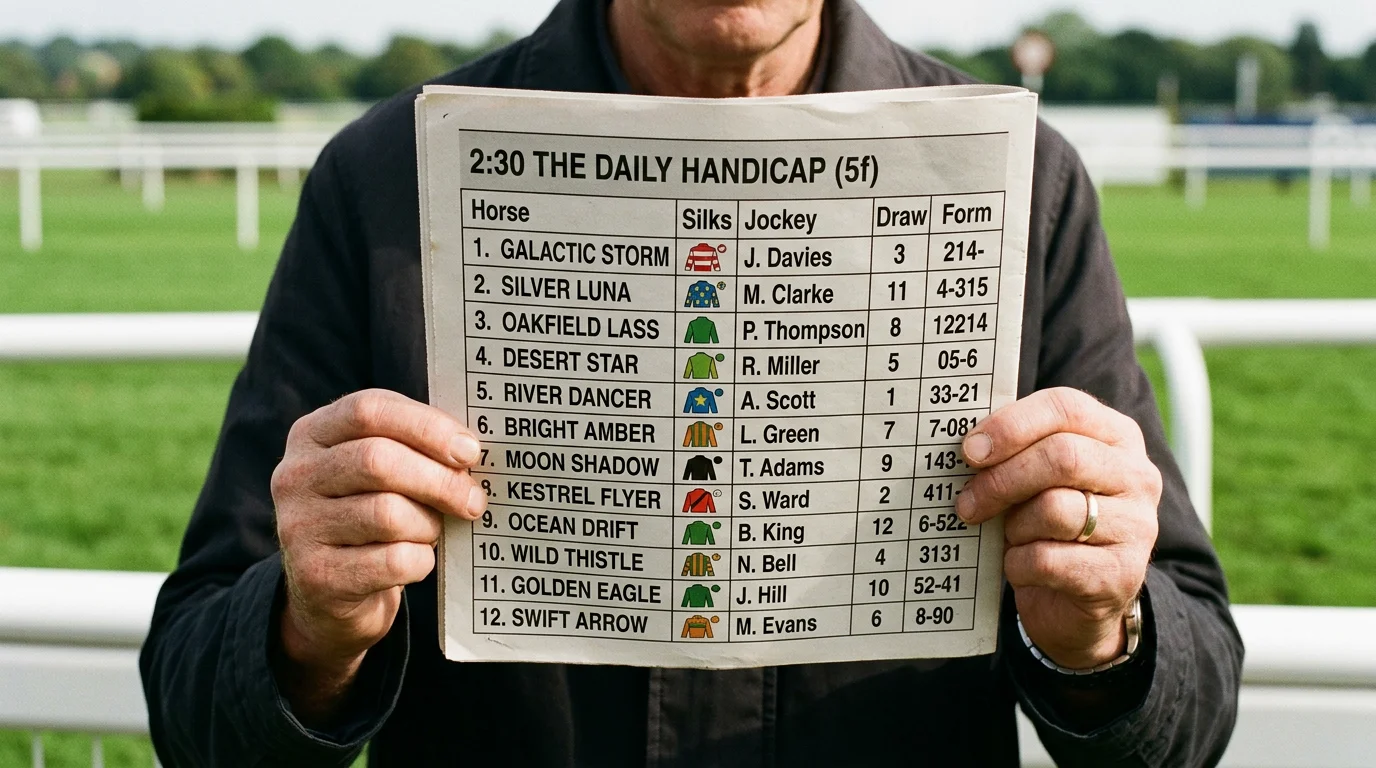
Each runner’s entry is a row of compressed data. Reading left to right on a typical newspaper or online racecard, you will see the cloth number (the number the horse carries on the course), the draw (stall position, Flat only), the horse’s name, its age, the weight it carries, the jockey, the trainer, and the form figures. Some racecards also display the Official Rating, the Timeform or RPR rating, the horse’s days since its last run, and a series of symbols or letters denoting equipment changes and other relevant information.
The form figures appear as a string of numbers and letters to the left of the horse’s name. These are the finishing positions from the horse’s most recent races, reading right to left (most recent run last). A form line of 2-4-1-0-3 means the horse finished second, fourth, first, out of the first nine, and third in its five most recent starts. The zero indicates a finish of tenth or worse. Some providers include letters: F for fell, U for unseated rider, P for pulled up, R for refused. In jump racing, these letters are especially important because they signal horses with jumping issues that a finishing position alone would not reveal.
The weight column shows the allocated handicap weight in stones and pounds. This is the weight the horse is expected to carry, including the jockey, saddle and any lead carried in a weight cloth. If the jockey cannot ride at the allocated weight, an overweight declaration will appear — typically noted as a number in brackets after the weight. The draw column, relevant only on the Flat, shows the starting stall number. On courses with known draw biases — Chester, Beverley, Musselburgh — this number can be as important as the form itself.
Headgear, Form Figures and Other Symbols Explained
The symbols printed alongside a horse’s name on a UK racecard encode equipment and status changes that carry genuine informational value. The most important are the headgear indicators. A lowercase “b” means blinkers — a hood that restricts the horse’s peripheral vision, forcing it to focus forward. A “v” indicates a visor, which is similar but with a slit that allows partial side vision. “p” denotes cheekpieces — strips of sheepskin attached to the cheek straps of the bridle. “t” indicates a tongue tie, a strap that prevents the horse from getting its tongue over the bit, which can obstruct breathing.
What matters is not just the presence of headgear but whether it is being applied for the first time. A horse wearing blinkers for the first time is marked with “b1” or “first-time blinkers” — a change that can produce dramatic improvement or no effect at all, depending on whether the headgear addresses the issue the trainer identified. First-time blinkers on a horse that has been racing lazily, refusing to put its head down, can unlock a level of ability the form figures do not yet reflect. First-time cheekpieces on a horse that jumps left over fences are a different intervention for a different problem. Reading the headgear change in context — what is the trainer trying to fix? — is a skill that the racecard provides the data for but does not interpret for you.
The Official Rating, shown on most modern racecards, is the BHA-assigned number that determines the horse’s handicap weight. The eleven handicappers on the BHA team update these ratings weekly, and the OR displayed on raceday reflects the most recent assessment. Comparing the OR with independent speed ratings — Timeform, RPR — directly on the racecard allows a quick cross-check: is the official mark in line with what the horse has been running to, or is there a gap that might indicate value?
The Five-Minute Handicap Assessment From a Racecard
You have five minutes before the race, the card in hand, and no time for deep form analysis. Here is the rapid assessment process. First, read the race header: class, distance, going, field size. These four facts set the parameters for everything that follows. Second, scan the form figures from right to left and eliminate any horse with a string of zeros, falls or pull-ups in its last three runs — unless there is an obvious change today (different going, first-time headgear, drop in class). Third, check the weight column: identify the top three by weight and the bottom three. The top weights are the best-rated and statistically the most likely to win; the bottom weights are the potential value plays if they are well handicapped.
Fourth, note any first-time headgear applications and any significant changes in jockey. A trainer booking a top rider for a horse that has recently been ridden by a claimer is making a statement about the horse’s chance. Fifth, check the draw on Flat races — if the course has a known bias (and you should know this before you arrive at the course), eliminate any horse drawn on the wrong side.
This process will not identify every winner, but it will narrow a twenty-runner field to a manageable shortlist of four or five in under five minutes. From there, a final glance at the prices tells you whether the market has already absorbed the information you have just extracted, or whether there is still value available. The racecard is your dashboard — and five minutes is enough to read every dial that matters.