
Grand National Handicapping: How Weights Are Set for the World's Most Famous Race
Best Greyhound Betting Sites – Bet on Greyhounds in 2026
Loading...
Forty Runners, Thirty Fences — and a Handicapper’s Puzzle That Captivates the Nation
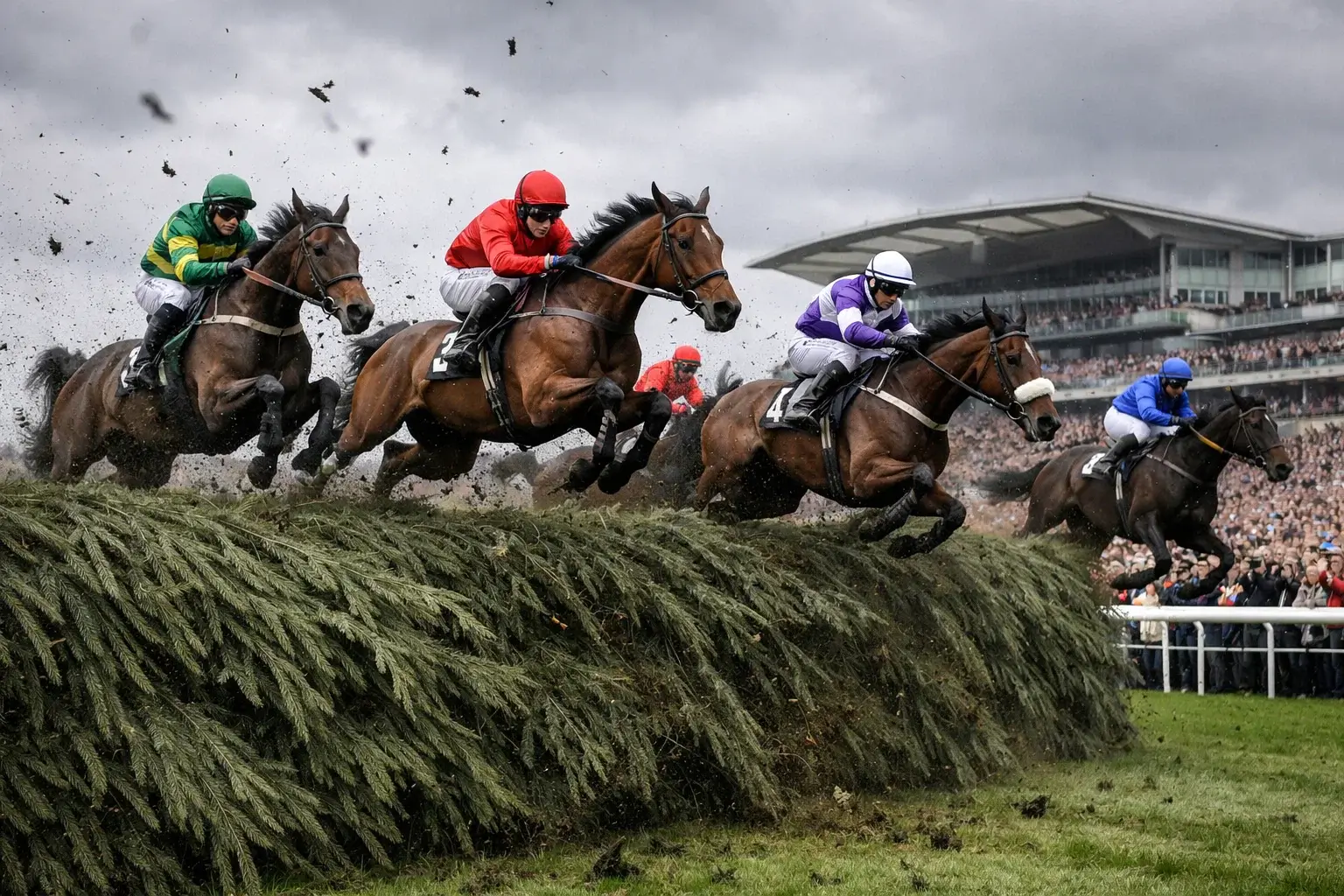
The Grand National is the ultimate handicap test — 30 fences, 40 runners and four miles, two furlongs and 74 yards of Aintree turf that has humbled champions and made heroes of outsiders for nearly two centuries. It is also, from a handicapping perspective, the most complex single race in the British calendar. The handicapper must separate forty-odd chasers across a weight range that can span more than two stone, knowing that the unique demands of the course — the spruce-topped fences, the long run-in, the sheer attrition of the distance — mean that his numbers will be tested in ways no other handicap can replicate.
Grand National handicap weights matter to the nation, not just to the racing public. Racecourse attendance across Britain reached 5.031 million in 2025, the first time the figure exceeded five million since before the pandemic, according to the BHA 2025 Racing Report. The Grand National meeting at Aintree accounts for a substantial slice of that total, pulling in casual racegoers and once-a-year bettors alongside the professionals. The weights, when published in February, generate headlines far beyond the sports pages — because for many people, the Grand National is the only handicap race they will ever bet on.
How Grand National Weights Are Compiled and Published
The BHA’s team of eleven handicappers compiles the Grand National weights, and the process follows the same principles as any other handicap — with a few notable exceptions dictated by the race’s unique conditions. The top weight is typically assigned a maximum of 11 stone 10 lb, and every other entry receives a weight calculated from the difference between its Official Rating and the top-rated horse. The resulting weight sheet is published in February, roughly seven weeks before the race, giving connections time to assess their horse’s chance and the public time to begin dissecting the puzzle.
The long gap between publication and race day introduces a variable that does not exist in ordinary handicaps. Horses can win or lose in the intervening weeks, their form can shift, and their ratings can change — but the published Grand National weights do not adjust. A horse that wins a competitive handicap chase in early March will carry the same weight at Aintree that it was assigned in February, even though its Official Rating may have been raised since. This creates an inherent tension: the weights represent a snapshot of the handicapper’s view at a single point in time, not a live assessment of the field that lines up in April.
The economic context surrounding the race has intensified too. Former Jockey Club CEO Nevin Truesdale highlighted the financial pressure on major jump meetings when he noted that staging costs for the Cheltenham Festival — run by the same organisation that manages Aintree — had climbed by more than half between 2019 and 2025. Similar cost pressures apply to Aintree, where the Grand National meeting must balance enormous operational expenses against the commercial imperative to attract the biggest possible audience. The weights, in this context, are not just a sporting mechanism; they are a commercial product that drives interest, debate and — above all — betting turnover for a race that sits at the heart of British racing’s economic model.
Because the entry list is much larger than the final field (typically 100-plus entries are whittled down to a maximum of 40 runners), there is also a long handicap element. Horses at the bottom of the weights — those whose ratings would require them to carry less than the minimum weight of 10 stone — are said to be out of the handicap. They race off the floor weight, which means they carry less than the handicapper thinks they should relative to the top weight. Whether this represents genuine value or merely confirms that they are the weakest runners in the field is a question the market wrestles with every year.
Historical Weight Trends: What Winning Profiles Tell Us
Grand National winners tend to cluster in a weight band that offers a clue to where the handicapper’s assessment is most likely to be favourable. Over the past three decades, the majority of winners have carried between 10 stone 2 lb and 11 stone, with the sweet spot sitting around 10 stone 7 lb to 10 stone 12 lb. Horses at the very top of the weights — 11 stone 7 lb and above — win rarely, not because they lack ability but because the gruelling distance and the relentless obstacles expose even small weight disadvantages over four-plus miles.
Age is another consistent filter. The race has been dominated by horses aged between eight and eleven, with nine and ten-year-olds providing the most winners. Younger horses — six and seven-year-olds — lack the experience to navigate Aintree’s unique fences safely, while older horses lose the stamina reserves needed to sustain effort over the full distance. The handicapper does not directly penalise for age, but the physical demands of the race impose their own age-related handicap that the form book alone does not fully capture.
Class of recent form matters too. Winners overwhelmingly come from horses that have run competitively at Grade 2 or Class 1 handicap level in the months before Aintree, rather than horses stepping up from Class 3 or 4 company. A horse does not need to have won recently — placed form in strong races is often a more reliable indicator than a victory in a weak contest — but it does need to have proved it belongs at a level close to the demands of the race itself.
Betting the Grand National Handicap: Data-Led Pointers
The once-a-year bettor throws a dart at the racecard. The serious punter filters the field. Start with the weight range that has historically produced winners and eliminate horses carrying more than 11 stone 4 lb or less than 10 stone — the extremes rarely win. Then filter by age: remove anything under eight or over twelve. Check the going record: Aintree in April typically rides good to soft, and a horse that has never won on ground softer than good is an uncomfortable proposition.
Jumping record is paramount and cannot be assessed from numbers alone. Every shortlisted horse should be checked via race replays from its last three or four chase starts. The Aintree fences are different from anywhere else — they are spruce-topped rather than standard birch, which means they require a slightly different technique — but a horse that jumps economically at Cheltenham or Haydock is unlikely to struggle at Aintree. One that has fallen or unseated in two of its last five starts, however, is a risk that no weight advantage can adequately compensate.
Finally, accept the inherent uncertainty. Even the best-filtered selection faces a field of forty in a race that takes nearly nine minutes and includes thirty major obstacles. The strike rate of any single selection, no matter how well-reasoned, is low. The ultimate handicap test punishes overconfidence and rewards humility — stake accordingly, and treat the Grand National as a puzzle to be enjoyed as much as solved.