
Going and Ground Conditions in UK Horse Racing: How Underfoot Terrain Shapes Handicap Results
Best Greyhound Betting Sites – Bet on Greyhounds in 2026
Loading...
Firm to Heavy — Why Two Inches of Rain Can Rewrite the Handicap
Going — the condition of the racing surface — is the single variable that can rewrite a handicap result overnight. A horse rated 85 on good ground may be worth 75 on heavy. A confirmed soft-ground specialist carrying a seemingly uncompetitive mark can become the best bet on the card after forty-eight hours of rain. No other factor shifts the competitive balance so dramatically between declaration day and the off.
The BHA publishes official going descriptions for every meeting, and courses now use penetrometer readings (the “going stick”) to quantify ground conditions on a numerical scale. But the descriptions — firm, good to firm, good, good to soft, soft, heavy — remain the primary language of the sport. Understanding what each term means in practice, and how individual horses respond to changes in the surface, is essential for anyone betting on handicaps. According to the BHA’s Q3 2025 Racing Report, Premier Flat meetings in 2025 attracted an average field size of 10.97 runners. Large fields amplify the impact of going, because the more runners in a race, the more horses will be running on ground that does not suit them. Ground truth — the surface that changes everything — starts with the scale.
The BHA Going Scale: Each Description Decoded
The BHA going scale runs from firm at one end to heavy at the other, with intermediate descriptions that indicate the transition. On turf — which accounts for the majority of Flat racing from April to November and all National Hunt racing — the full sequence reads: hard, firm, good to firm, good, good to soft, soft, heavy. Hard ground is rare in Britain and almost never declared officially; it carries welfare implications and courses will water the track to avoid it.
Firm ground is fast. The surface has dried out sufficiently that there is minimal give underfoot. Horses with a low, efficient action tend to excel. Jarring is a risk, and some trainers will withdraw confirmed soft-ground performers rather than risk injury on a firm surface. Good to firm is the default summer going at well-maintained courses: quick enough for speed horses, with enough cushion to protect joints. Most horses handle it.
Good ground is the neutral gear. It offers neither significant speed advantage nor heavy-ground slog. Results on good ground tend to reflect ability most cleanly, which is why the BHA uses good ground as the baseline for rating calculations. If a horse runs a performance rated 85 on good ground and another runs a performance rated 85 on soft, the handicapper has already factored in a going adjustment to make the numbers comparable.
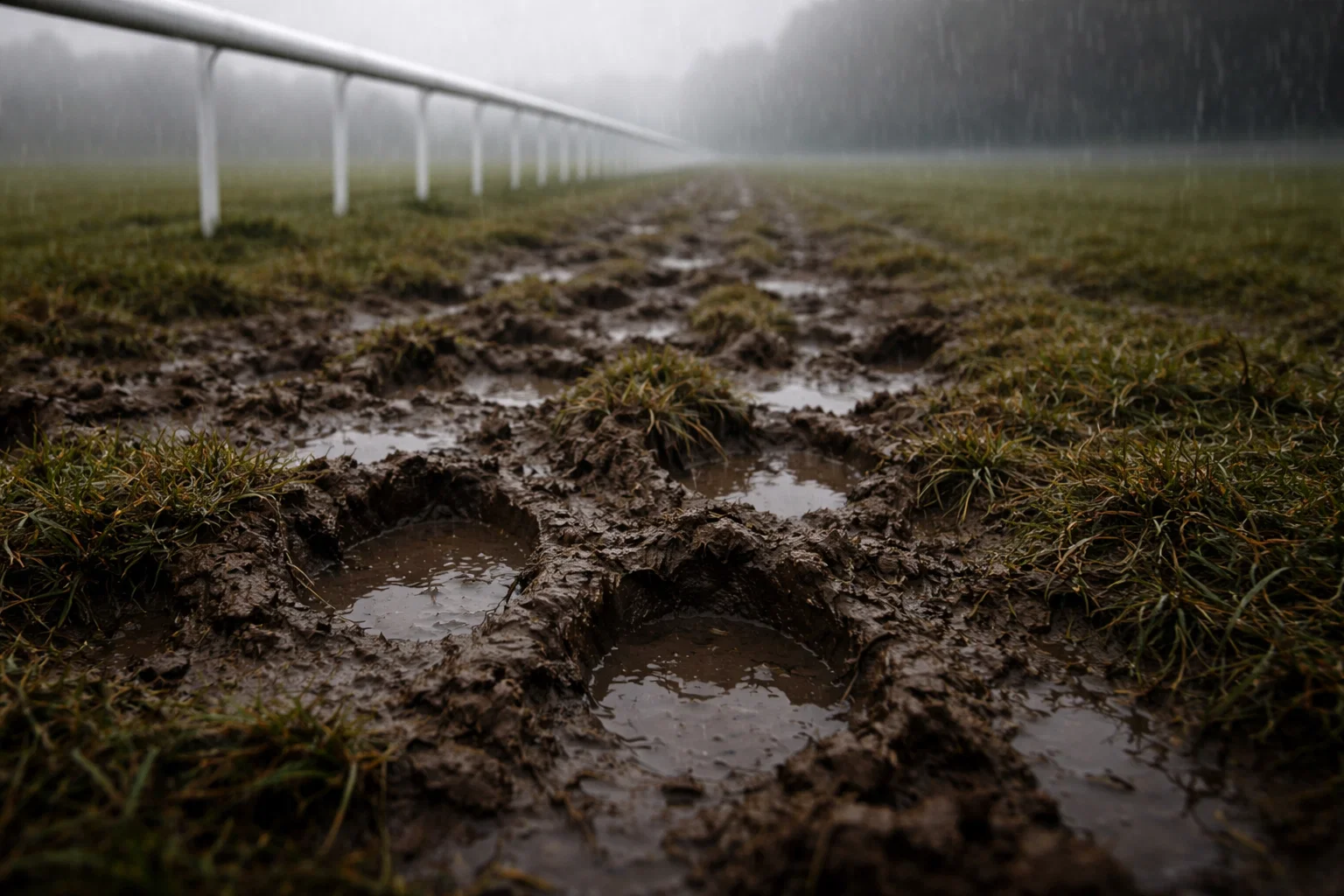
Good to soft marks the transition into winter territory. The ground has taken on moisture, and horses need to be able to cope with a degree of give. Some improve sharply; others simply do not handle it. Soft ground is demanding. Races are run at a slower pace, stamina becomes more important than raw speed, and horses with a pronounced knee action — picking their feet up higher, like a trotting horse — tend to be better suited. Heavy ground is the extreme: waterlogged, energy-sapping, and race-changing. Fields thin because many trainers refuse to risk their horses. Those that do run tend to be proven heavy-ground performers, which can paradoxically produce more predictable results.
All-weather surfaces — Polytrack, Fibresand, Tapeta — sit outside this scale. Their synthetic composition means they are not affected by rainfall in the same way, and the going is typically described simply as standard, standard to slow, or slow. All-weather form is its own sub-discipline, and many punters treat it as a separate dataset when analysing handicaps.
How Going Shifts the Competitive Balance in Handicaps
Going does not merely affect how fast a race is run. It changes which horses are competitive. In a handicap, that redistribution of advantage can flip the expected running order. A horse rated 82 on good ground might be a mid-division finisher at best, but if the ground turns soft and it holds proven form on that surface, it becomes a live contender — without its rating changing by a single point.
The handicapper accounts for going in assessments, but only retrospectively. After a race on heavy ground, the BHA team adjusts performance ratings using going allowances — standardised corrections that estimate how much slower (or faster) a surface ran compared to the baseline. These adjustments are reasonably accurate in aggregate, but they cannot capture individual variation. Some horses lose three lengths on soft ground; others gain five. The standard going allowance treats all runners the same, which creates the kind of systematic mispricing that punters can exploit.
Race programming adds another layer. Britain’s racecourses are not uniform in drainage. Courses like Newmarket and Salisbury, built on chalk downland, drain quickly and rarely ride heavier than good to soft. Courses like Haydock and Cheltenham, on clay or loam, hold moisture and can turn from good to heavy after sustained rain. When the going changes late — between declaration time and raceday — the impact is sharpest, because many trainers declared their horse expecting different conditions. Non-runners multiply, the remaining field is reshaped, and the betting market reprices in real time. For punters monitoring forecasts and going updates, this window of repricing is an opportunity. The BHA’s Q3 2025 report noted that 82.2 percent of British races started within two minutes of their scheduled time, meaning reliable going reports are available close to the off — late enough for conditions to be confirmed but early enough to act.
Finding Ground Specialists: Form Patterns That Predict
A ground specialist is a horse whose form diverges sharply depending on the surface. Identifying them is not difficult — it requires consistency in method, not brilliance. The approach is simple: filter a horse’s career form by going description and compare the strike rates.
Start with the racecard. Most form guides allow you to sort past performances by going. A horse that shows form figures of 1-2-1-3 on soft and heavy ground but 0-7-8-0 on good to firm is not a mystery. It thrives with cut in the ground and struggles when the surface dries out. Its Official Rating, which blends all performances, will understate its ability on soft ground and overstate it on quick ground. That is your edge: betting it when the going suits and ignoring it when it does not.
Pedigree supports the assessment. Sires pass on going preferences to their offspring with remarkable consistency. Sons and daughters of Nathaniel, for example, tend to handle soft ground well. Progeny of Frankel generally prefer a sounder surface. These are tendencies, not laws — but when a horse’s form and breeding point in the same direction, the signal strengthens.
The sharpest value arises when a ground specialist has been running on the wrong surface. If its rating has dropped because of poor results on quick ground and the forecast turns to rain, the market may not adjust quickly enough. Bookmakers price handicaps based on overall form; they do not always weight going preference as heavily as the data warrants. A horse whose mark has fallen four pounds after three runs on good to firm, returning to soft ground where it previously won, is not the same proposition it appeared on paper — and the odds may not reflect the difference until closer to the off.
Tracking going preferences is low-effort, high-information work. It requires a spreadsheet, access to form data, and the patience to watch how individual horses move on different surfaces during race replays. The surface that changes everything rewards those who pay attention to it systematically rather than reacting to it on the day.