
Each-Way Betting on Handicap Races: How Large Fields Create Place-Profit Opportunities
 Available in US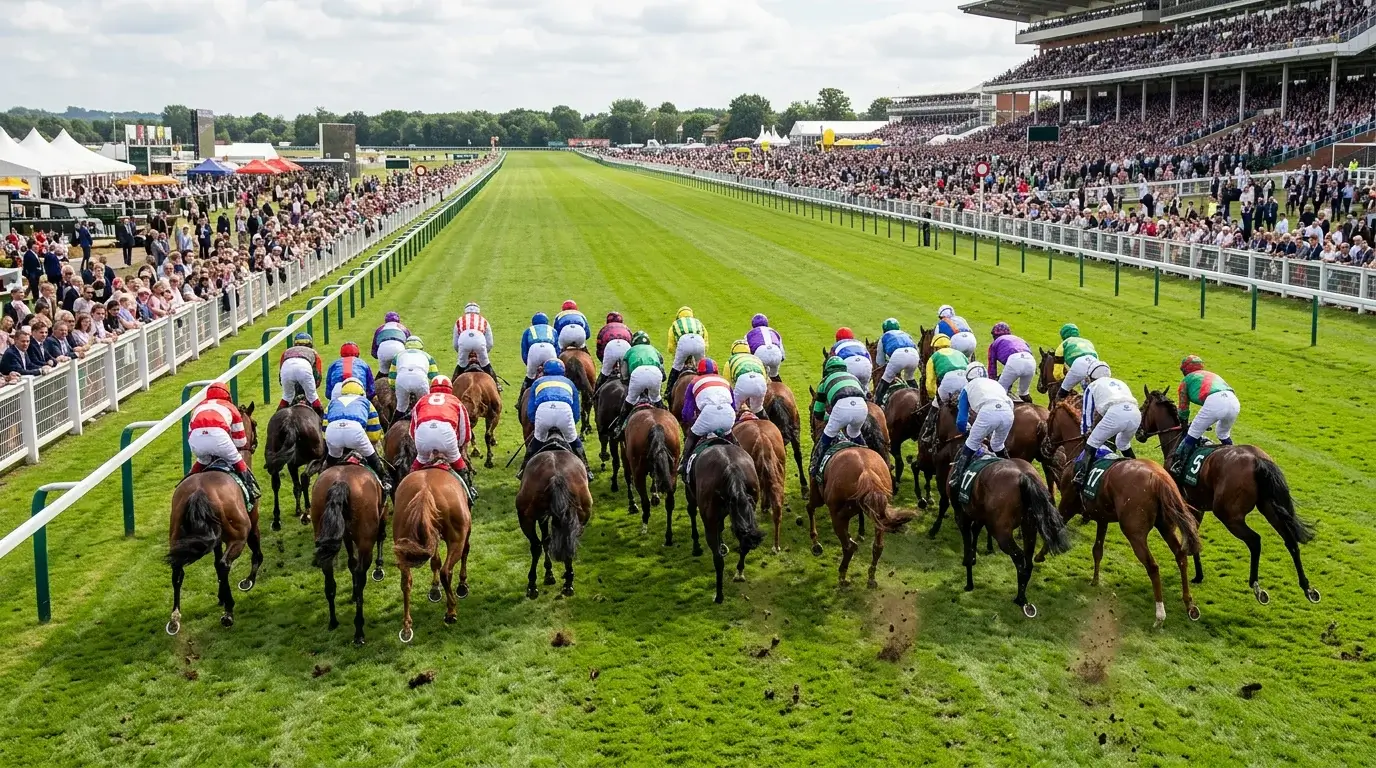
Why Handicaps With 16+ Runners Are Built for Each-Way Profit
Each way betting handicap races value is not a vague concept — it is a mathematical reality that depends on specific conditions, and those conditions appear most frequently in large-field handicaps. When sixteen or more runners line up, standard bookmaker terms extend the place payout from three places to four, and the fractional odds paid on the place part shift to one-quarter of the win price. That extra place, combined with the compressed odds structure of a competitive handicap, creates a zone where the place part of an each-way bet can generate profit even when the horse does not win.
The numbers bear this out at the structural level. At Premier Flat meetings in 2025, average field sizes reached 10.97 runners per race, according to the BHA Racing Report — and that is the average. Heritage handicaps at Ascot, Goodwood and York regularly attract fields of twenty or more, where the place terms expand further and the each-way arithmetic becomes even more favourable. Saturday cards during the summer frequently feature three or four handicaps that clear the sixteen-runner bar, which means each-way specialists can build an entire betting strategy around the season’s natural rhythm. The place part pays — when you pick the right race — and handicaps with sixteen-plus runners are where the right race is most often found.
Each-Way Basics: Win Part, Place Part and the Terms
An each-way bet is two separate bets combined: one on the horse to win and one on the horse to place. Each part carries the same stake, so a £10 each-way bet costs £20 in total. The win part pays out at the full advertised odds if the horse wins. The place part pays out at a fraction of those odds — typically one-fifth or one-quarter — if the horse finishes within the place terms defined by the bookmaker.
Place terms vary by field size and by bookmaker, though the industry standard has become well established. In races with five to seven runners, only the first two count as places, and the place fraction is one-quarter of the win odds. With eight to fifteen runners, the first three places count, and the fraction remains one-quarter. Once the field hits sixteen or more, the place terms extend to four places at one-quarter odds — and some bookmakers offer enhanced terms of one-fifth odds to five places for selected major handicaps, particularly heritage events.
The mechanics sound straightforward, and they are. But the subtlety lies in what the place fraction means in the context of a competitive handicap. If a horse is priced at 16/1 in a twenty-runner handicap, the place part pays at 4/1 (one-quarter of 16/1) for a top-four finish. The question then becomes: is this horse likely to finish in the first four at least often enough to compensate for the total stake? If you believe it has a 25% or better chance of placing, the bet has positive expected value on the place component alone. The win part becomes a bonus rather than a requirement.
The Handicap-Specific Edge: Competitive Fields and Compressed Odds
Handicaps are structurally suited to each-way betting in a way that non-handicap races are not. The entire purpose of the handicapping system is to compress the field — to make every horse in the race theoretically capable of winning by assigning weight differentials that equalise ability. In a well-framed handicap, the difference between the best-rated and worst-rated runner might be 20 lb, but the weight adjustments are designed to offset that gap. The result is a race where the market prices are relatively compressed: instead of a 2/1 favourite and a 100/1 outsider, you get a 6/1 favourite and a 25/1 outsider, with the bulk of the field clustered between 8/1 and 16/1.
That compressed price structure is exactly what each-way bettors want. The tighter the odds range, the more likely it is that a mid-priced horse finishes in the places, and the more generous the place odds become relative to the actual probability. In a non-handicap race where the favourite is 6/4 and the second favourite is 4/1, the place market is dominated by the front two — there is little room for a 14/1 shot to finish in the top three. In a handicap where six horses are priced between 8/1 and 14/1, any of them could feasibly place, and the each-way returns on the ones that do are substantial.
Data from long-term UK handicap analysis by geegeez.co.uk adds another dimension. The top three horses by weight in UK handicaps produce a combined strike rate of around 37% — meaning that, between them, they win more than a third of all handicap races. For each-way purposes, this is relevant because higher-weighted horses are generally the most reliable — they are at the top of the weights because they are the best-rated, and their form is the most exposed and trustworthy. Shortlisting from the top half of the handicap, then looking for value in the each-way market among horses priced between 8/1 and 20/1, is a framework that concentrates analysis where the form is strongest and the each-way mathematics most favourable.
Field Size Thresholds: When E/W Maths Tip in Your Favour
The crucial threshold is sixteen runners. Below that number, standard terms offer three places at one-quarter odds. Above it, the terms extend to four places at the same fraction. That extra place makes a significant difference to the long-run profitability of each-way betting because it widens the zone in which the bet returns money. A horse that finishes fourth in a fifteen-runner race returns nothing on the place part. The same horse finishing fourth in a sixteen-runner race pays out at a quarter of the win odds.
The practical implication is that each-way punters should build their analysis around races that are likely to attract sixteen or more declared runners. The entries stage — published several days before declarations — gives an early indication of likely field size. If a Class 2 handicap at Newmarket has twenty-four entries, it is almost certain to have sixteen or more at the final declaration stage. If a Class 4 handicap at Catterick has twelve entries, the final field may drop to nine or ten, and the each-way terms will be less favourable.
For selected major handicaps, bookmakers offer enhanced each-way terms as a promotional tool — typically five or six places at one-fifth of the odds. These promotions are most common during festival weeks and on major Saturdays, and they shift the mathematics further in the punter’s favour. A horse at 20/1 with five places at one-fifth odds pays 4/1 for a top-five finish — a proposition that requires only a 20% place probability to break even. In a twenty-runner handicap where the form is competitive, several horses will have a 20% or better chance of finishing in the first five. Finding them is the analytical challenge. The structure does the rest.
Each-Way Betting on Handicap Races — More on this topic at horse betting handicapping.
See also Speed Figures for UK Horse Racing.
